1. Introduction: Why Portable Laser Welding Robots Are Transforming Manufacturing
Welding is one of the most important manufacturing processes in modern industry. From automotive components and new energy vehicle (NEV) battery structures to precision sheet metal, stainless steel equipment and metal enclosures, welding quality directly affects product strength, dimensional accuracy and production efficiency.
Traditional welding methods, including manual TIG and MIG welding, remain widely used. However, manufacturers increasingly face several challenges:
Shortages of experienced welding operators.
Inconsistent weld quality between different operators.
High requirements for precision when welding thin metal sheets.
Excessive heat input and thermal deformation in certain applications.
Limited flexibility when switching between different workpieces.
High integration costs for conventional fixed robotic welding cells.
Laser welding offers another approach. By concentrating energy into a relatively small area, laser welding can produce narrow weld seams with high energy density and controlled heat input.
However, traditional fixed laser welding equipment is not always suitable for manufacturers handling multiple product types, small batches and large or irregular workpieces.
This is where the Jitri Portable Laser Welding Robot, developed by Jiangsu Jitri Intelligent Manufacturing Technology Research Institute Co., Ltd. (IIMT), provides an alternative.
By integrating a collaborative robot arm, fiber laser welding technology, 3D vision and flexible deployment capabilities, Jitri aims to make robotic laser welding more accessible to manufacturers that require both precision and production flexibility.
2. What Is a Portable Laser Welding Robot?
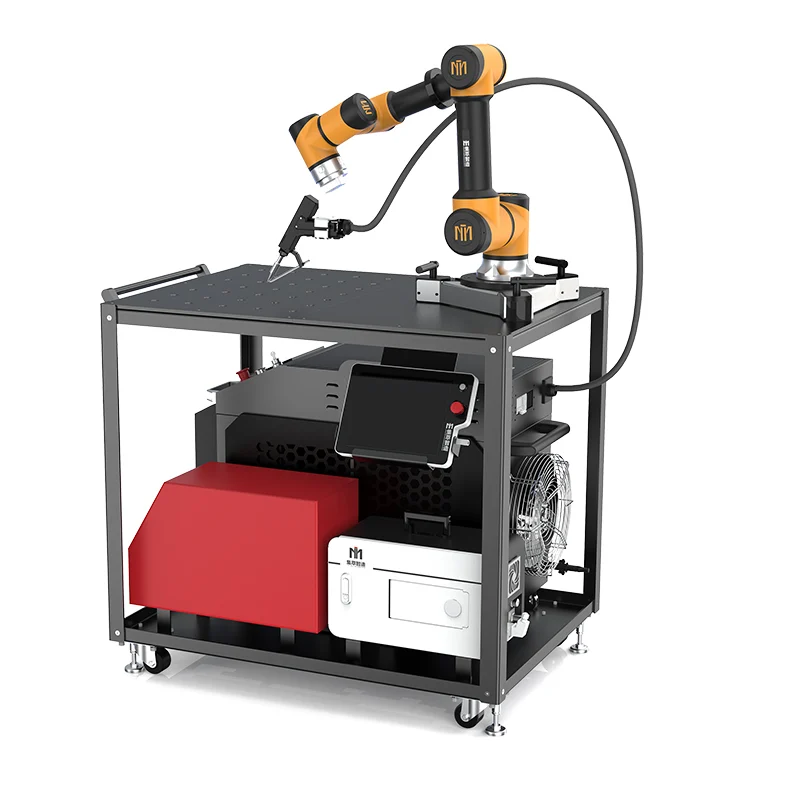
A portable laser welding robot is an integrated welding automation system designed to combine laser welding technology with robotic motion control and flexible positioning.
Unlike conventional stationary welding systems, a portable robotic welding solution can be relocated between production stations according to manufacturing requirements.
A typical system consists of:
Collaborative Robot Arm: Controls the movement and positioning of the welding head.
Fiber Laser Welding System: Provides a concentrated laser energy source for metal joining.
Laser Welding Head: Focuses the laser beam onto the designated welding area.
3D Vision System: Helps identify workpiece geometry and welding positions.
Laser Seam Tracking: Supports the identification and correction of welding trajectory deviations.
Intelligent Control System: Coordinates robot movement, welding parameters and operating procedures.
Portable Base: Supports flexible positioning and relocation between workstations.
The combination of these technologies helps manufacturers automate welding tasks without necessarily building a completely new fixed production line.
3. Jitri Portable Laser Welding Robot: Key Product Advantages
Jitri focuses on developing practical robotic welding solutions for manufacturers that need precision, flexibility and simplified operation.
Its portable laser welding robot combines collaborative robotics, fiber laser welding and intelligent vision technologies.
3.1 High-Precision Collaborative Robot Technology
The Jitri portable laser welding robot adopts a collaborative robot platform with a payload range of 5–10 kg.
According to IIMT's published product information, the robot platform provides repeatability of ±0.02 mm.
This specification is particularly relevant to applications requiring consistent robot positioning and repeatable welding trajectories.
Key benefits include:
Consistent movement along programmed welding paths.
Accurate positioning of the laser welding head.
Support for repetitive welding operations.
Improved process consistency in automated production.
It is important to distinguish robot repeatability from final welding accuracy. Actual weld quality also depends on workpiece positioning, joint preparation, fixture accuracy, material properties, laser parameters and process validation.
3.2 3D Vision and Intelligent Laser Seam Tracking
One of the major challenges in robotic welding is that actual workpiece positions do not always perfectly match theoretical CAD models or programmed coordinates.
Manufacturing tolerances, assembly deviations and fixture variations can cause welding trajectories to shift.
Jitri integrates 3D vision and laser seam tracking technologies to help the system identify welding positions and respond to deviations.
This provides several potential advantages:
Improved identification of complex workpiece geometries.
More accurate welding-path positioning.
Reduced dependence on perfectly aligned workpieces.
Better adaptability to different product configurations.
More flexible robotic welding for small-batch production.
For manufacturers dealing with customized metal components, intelligent sensing can help reduce the amount of manual adjustment required during production.
4. Jitri Portable Laser Welding Robot: Technical Specifications
The following specifications are based on the product information published on IIMT's official website.
Technical Item | Jitri Portable Laser Welding Robot |
|---|---|
Product Type | Portable Laser Welding Robot |
Robot Platform | Collaborative Robot |
Payload | 5–10 kg |
Repeatability | ±0.02 mm |
System Dimensions | 1,200 × 800 × 915 mm |
Working Range | 900–1,300 mm |
Welding Head | Laser Welding Head / Handheld Laser Welding Torch |
Welding Wire Diameter | 0.8–1.6 mm |
Filler Wire | With or Without Filler Wire |
Vision Technology | 3D Vision |
Seam Tracking | Laser Seam Tracking |
Teaching Method | Drag Teaching |
Deployment | Portable Design with Magnetic Base |
Note: Laser power, maximum welding thickness, welding speed, material-specific process windows and protection configuration are not specified in the published product specification. These parameters should be confirmed with IIMT based on the actual application.
5. Real Industry Data: Why Laser Welding Matters
The adoption of laser welding is supported by developments in manufacturing technology and industrial research.
According to the U.S. Occupational Safety and Health Administration (OSHA), laser technology is used across multiple industrial processes, including materials processing, cutting and welding.
Research published in Welding in the World in February 2026 also examined the beam characteristics of handheld laser welding systems, highlighting the continued technical development of portable laser welding technology.
A 2025 review published in the Journal of Manufacturing Processes (Volume 152, pages 588–615) examined temperature distribution, residual stress and deformation in laser and hybrid welding.
These studies demonstrate that thermal management and process control remain important considerations when selecting a laser welding solution.
Why Are Manufacturers Interested in Laser Welding?
1. Concentrated Energy Input
Laser welding uses a highly concentrated energy source, enabling localized heating and potentially reducing the heat-affected area compared with some conventional welding processes.
2. Potentially Lower Thermal Distortion
For suitable materials and process parameters, controlled laser energy input can help reduce overall thermal distortion.
However, deformation depends on material properties, thickness, joint design, clamping and welding parameters.
3. High Automation Potential
Laser welding can be integrated with industrial robots, vision systems and automated production equipment.
This makes it suitable for manufacturers seeking repeatable and digitally controlled welding processes.
6. Applications of Jitri Portable Laser Welding Robots
The Jitri portable laser welding robot is designed for manufacturers that require flexible welding automation.
Potential application scenarios include the following.
6.1 Automotive and New Energy Vehicle Components
<Add relevant product application image>
The automotive and NEV industries require reliable welding processes for metal structures, brackets, enclosures and selected battery-related components.
Portable robotic laser welding can be evaluated for:
Precision metal brackets.
Battery housing components.
Stainless steel structural parts.
Sheet metal assemblies.
Customized automotive components.
The suitability of laser welding for battery-related applications must be assessed against material specifications, joint design and battery safety requirements.
6.2 Stainless Steel Fabrication
<Add relevant product application image>
Stainless steel manufacturing frequently involves thin plates, customized structures and precision metal fabrication.
Potential applications include:
Stainless steel cabinets.
Metal enclosures.
Kitchen equipment.
Industrial equipment housings.
Precision sheet metal components.
Laser welding can be particularly attractive where a narrow weld seam and controlled thermal input are important.
7. Portable Laser Welding Robot vs. Traditional Welding Methods
Different welding processes serve different manufacturing requirements. Laser welding is not automatically the best choice for every application.
Comparison | Manual TIG/MIG Welding | Fixed Robotic Laser Welding | Jitri Portable Laser Welding Robot |
|---|---|---|---|
Operation | Manual | Automated | Automated |
Deployment | Flexible | Usually fixed | Portable |
Energy Source | Electric Arc | Laser | Fiber Laser |
Programming | Manual skill | Robot programming | Drag teaching |
Vision Integration | Optional | Application-dependent | 3D Vision |
Seam Tracking | Application-dependent | Optional | Laser Seam Tracking |
Production Flexibility | Operator-dependent | Depends on cell design | Designed for flexible deployment |
Best-Suited Scenarios | Various manual welding tasks | Repetitive automated production | Flexible laser welding applications |
The key difference is not simply welding technology. It is how the equipment fits into the manufacturer's production environment.
For large-scale standardized production, fixed robotic laser welding cells may provide an appropriate solution.
For workshops handling multiple product types and changing production requirements, a portable system can offer additional flexibility.
For thick materials, difficult joint geometries or applications requiring gap bridging, conventional arc welding or hybrid processes may be more suitable.
8. Why Choose Jitri (IIMT) for Portable Laser Welding Automation?
Jiangsu Jitri Intelligent Manufacturing Technology Research Institute Co., Ltd. (IIMT) focuses on collaborative robotics, industrial automation and intelligent manufacturing solutions.
Rather than focusing only on the robot arm, Jitri emphasizes the integration of robotic motion control, welding equipment, intelligent vision and application-oriented automation.
Key product advantages include:
Integrated Robotic Welding Solution
Combines collaborative robotics, laser welding equipment, vision technology and intelligent control.
Precision-Oriented Motion Control
The published robot platform repeatability is ±0.02 mm.
Flexible Production Deployment
A portable configuration helps manufacturers adapt welding equipment to changing production layouts.
Simplified Operation
Drag teaching and a built-in welding expert database help reduce the learning barrier.
Multiple Welding Equipment Options
Supports welding equipment from several established industrial brands.
Application-Oriented Development
IIMT provides robotic solutions for different industrial applications, including metalworking, automotive manufacturing and smart factories.
For manufacturers evaluating portable laser welding automation, Jitri offers an integrated approach that combines robotic flexibility with laser welding technology.
9. Laser Welding Safety: An Important Consideration
Laser welding equipment requires appropriate safety management.
High-power laser beams can cause serious eye and skin injuries. Therefore, portable laser welding should never be considered safe simply because the robot is collaborative or the equipment is movable.
Manufacturers should evaluate:
Laser classification and protective enclosure requirements.
Appropriate laser safety eyewear.
Interlocks and emergency-stop systems.
Restricted access to the laser processing area.
Operator training and safety procedures.
Extraction and ventilation for welding fumes.
Fire prevention and electrical safety.
10. Conclusion: Make Welding More Flexible with Jitri
The future of welding automation is not limited to large, fixed production lines.
As manufacturers increasingly require flexible production, shorter changeover times and improved welding consistency, portable robotic welding solutions are becoming an important option for modern metal fabrication.
The Jitri Portable Laser Welding Robot combines collaborative robotics, fiber laser welding, 3D vision, laser seam tracking and portable deployment to address the practical challenges of flexible manufacturing.
With a published 5–10 kg payload range, ±0.02 mm robot repeatability and a 900–1,300 mm working range, IIMT provides a robotic laser welding solution designed for manufacturers seeking a balance between precision, flexibility and automation.
Whether you manufacture automotive components, stainless steel products, electrical equipment or customized metal structures, Jitri is ready to explore how intelligent laser welding can improve your production process.
Jitri (IIMT) – Intelligent Robotics. Flexible Manufacturing. Smarter Welding.
Contact IIMT:
Website: https://www.iimtcobot.com/
Product Page: https://www.iimtcobot.com/products/portable-laser-welding-robot/
Email: sales@iimt.org.cn
WhatsApp: +86 199 5171 9396
Company: Jiangsu Jitri Intelligent Manufacturing Technology Research Institute Co., Ltd.
Location: Nanjing, Jiangsu, China
Contact our team today to discuss your portable laser welding automation requirements.