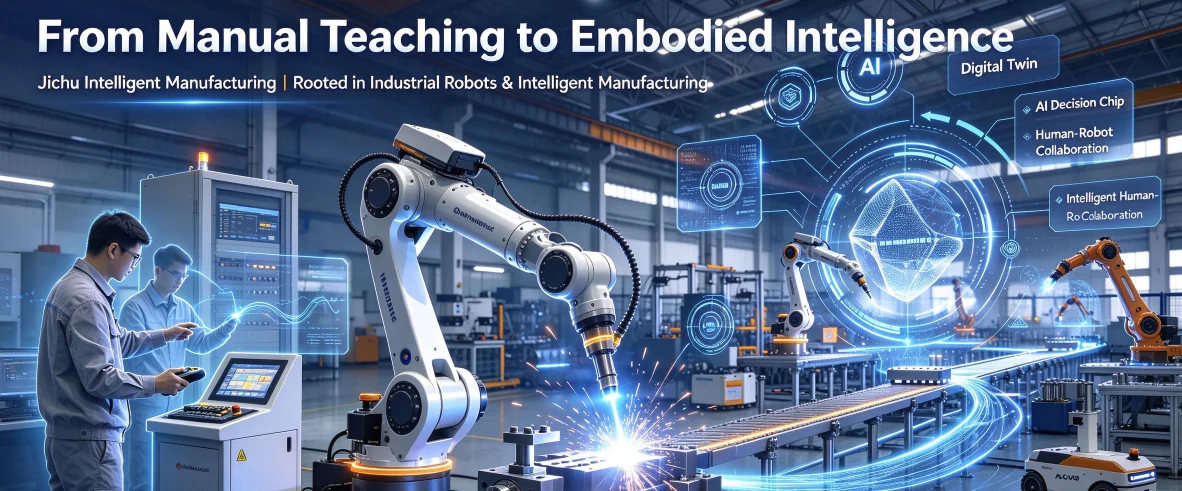
In October, at the National Conference on the Development of Tailored Intelligent Robot Ecology and Innovation of Industry Education Integration, a special place was unveiled - it is not for human use, but for robots to "go to school".
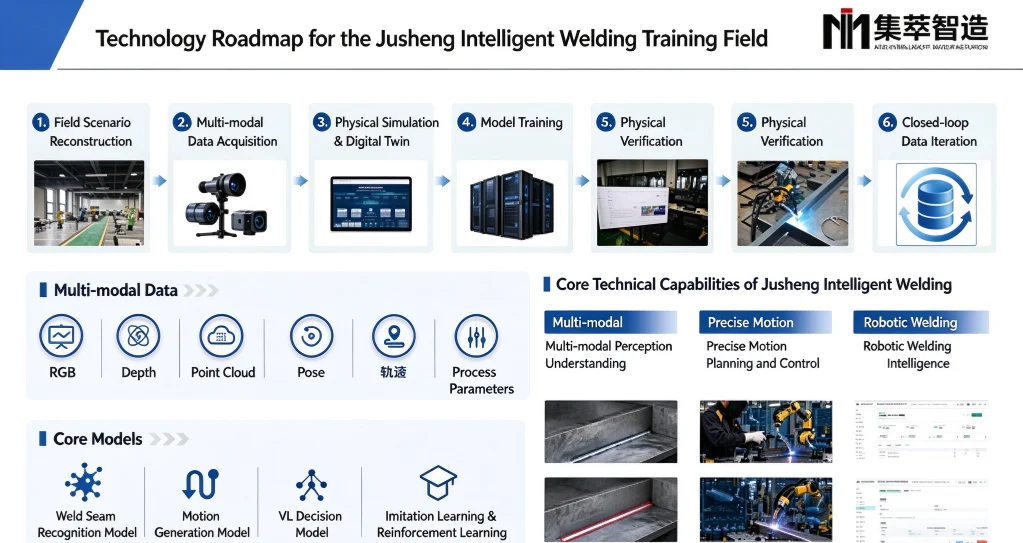
This is the "Tailored Intelligent Welding Training Field" jointly built by Jicui Intelligent Manufacturing and Nanjing Jiangbei New Area. It is aimed at the most typical and challenging scenario of welding in industrial manufacturing, and constructs a technical closed loop of "multimodal data acquisition model training actual verification continuous iteration".
In the past two years, robots have become more and more human like as they can dance, flip their heads, and speak. But in the factory workshop, it is still a world-class challenge to weld a difficult angle irregular weld. The completion of this training ground aims to answer a question: how to make welding robots move from being "performable" to being "truly useful".
01 Welders are becoming increasingly difficult to find
Craftsmanship is becoming increasingly difficult to pass on
Let's take a look at a few sets of data first. According to public reports, data released by the Ministry of Human Resources and Social Security shows that there is a shortage of over 3 million welders nationwide; According to the statistics of the Steel Structure Industry Association, the total proportion of welders born in the 1960s and 1970s is as high as 61%, while those born in the 1990s only account for 13%. The skilled talent pool is facing the risk of a talent gap; The average age of technical workers in the construction industry has reached 55 years old, with less than 15% of welders under the age of 35.
Behind the numbers lies a triple dilemma.
It's difficult to recruit people. The welding environment is hot, noisy, and laborious, and the number of young people willing to enter is decreasing. The shortage of high-end welding talents continues to widen.
The difficulty lies in the unstable quality. Welding highly relies on personal experience, and the quality of welds varies among different welders for the same workpiece. The experience of experienced technicians is difficult to standardize and replicate.
The three difficulties lie in the difficulty of transmitting craftsmanship. The control of temperature, speed, and force relies on years of practical experience and accumulated "hands-on skills". When people retire, their skills are also taken away - this is the most realistic and difficult talent gap.
Why is 02 a training ground
Not in the laboratory
Faced with pain points, many companies have turned their attention to robots. But in the past, robot welding mainly relied on two paths:
One is the master's hands-on teaching
The second is to set the action path in advance.
The idea behind the construction of this training ground by Jicui Intelligent Manufacturing is completely different: not to program robots, but to enroll them in school.
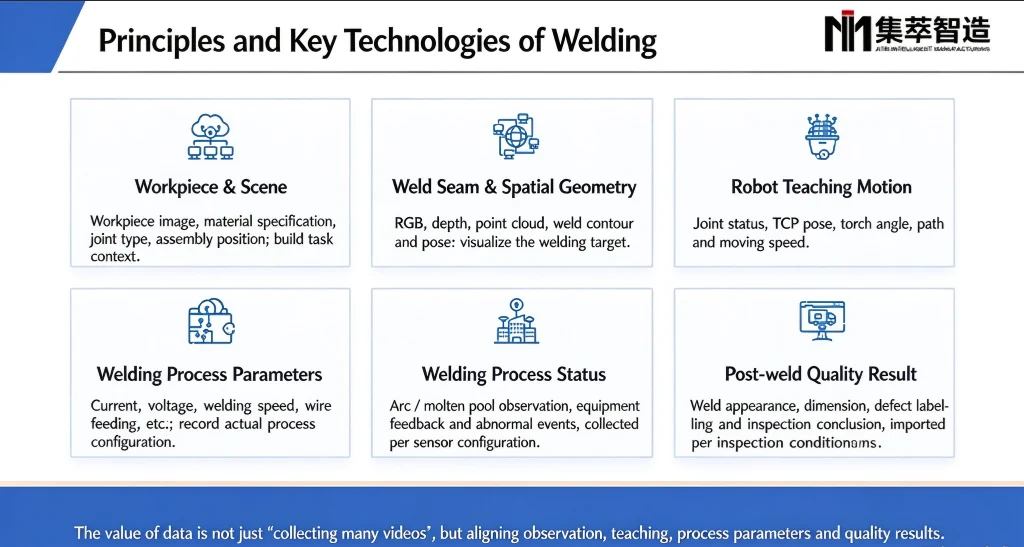
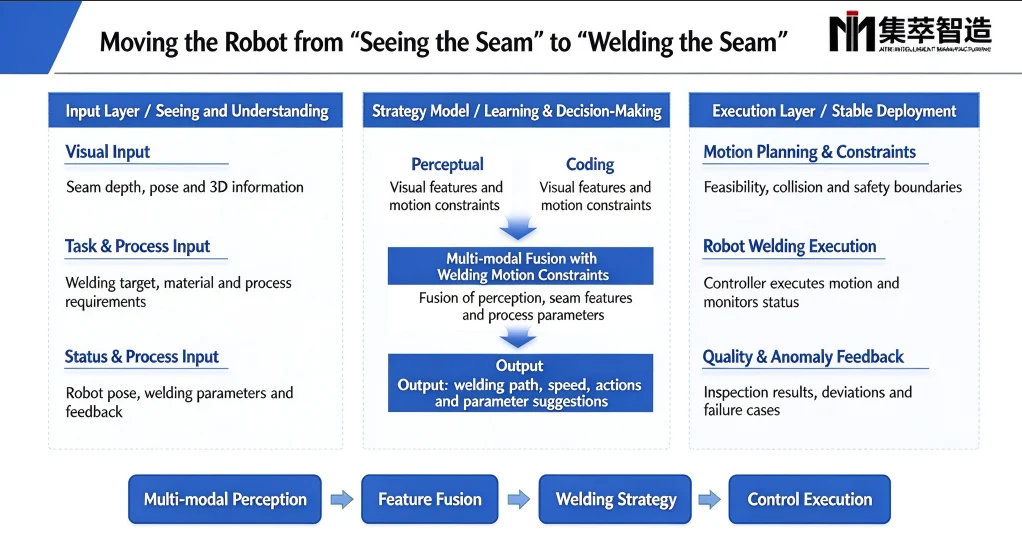
In the training ground, cameras and various sensors are set up on site to record massive amounts of data under real working conditions, training the "brain" of the model; Robots have their own "workstations", simulating typical welding scenarios such as shipbuilding and engineering machinery, practicing while optimizing based on quality inspection results, understanding welding and accumulating experience through trial and error.
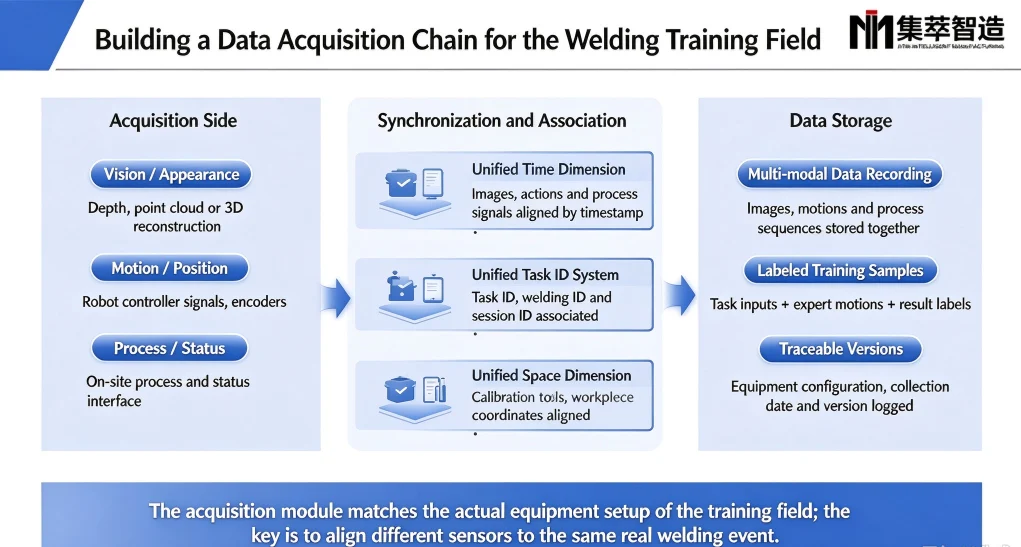
This is precisely what sets it apart from ordinary laboratories: it is not a closed virtual simulation, but a real working condition training environment built on physical robot equipment. Let data continuously flow back from real scenarios, and then drive continuous iteration of large models - from "beautiful demonstrations" in exhibition halls to "useful equipment" in factories.
03 Rewrite the Welding Industry
Talent logic and quality logic
The long-term value of this training ground goes far beyond making a robot smarter.
For the industry, it transforms the "experience of old masters" into trainable and replicable data assets, allowing welding processes to no longer rely on the personal abilities of individual experts, but instead precipitate into a sustainable iterative system - providing a fundamental new path to solving recruitment difficulties and aging.
For talents, it provides a physical carrier for various universities to carry out practical training and engineering verification in the direction of embodied intelligent welding, enabling the integration of industry and education to truly land, and providing a growth soil for the new generation of welding technology talents that is close to the real production line.
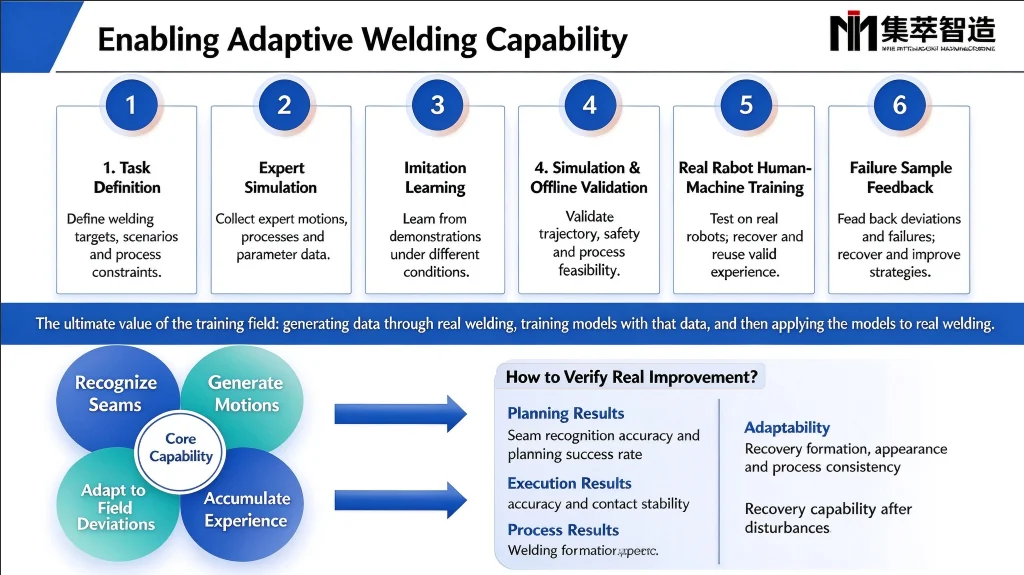
It can be said that this is a milestone in the intelligent upgrading of the welding industry: from "humans teaching machines" to "machines evolving in real scenarios". And Jicui Intelligent Manufacturing is the explorer and leader of this transformation.