Introduction: The Future of Welding Automation with IIMT (Jiangsu Jitri)
Welding has always been a critical process in manufacturing industries such as automotive, metal fabrication, steel structures, agricultural machinery, and industrial equipment. However, traditional manual welding faces several challenges, including skilled labor shortages, inconsistent welding quality, high labor intensity, and workplace safety risks.
With the development of Industry 4.0 and intelligent manufacturing, robotic welding has become an important solution for manufacturers seeking higher efficiency, better consistency, and flexible production.
IIMT (Jiangsu Jitri Intelligent Manufacturing Technology Research Institute Co., Ltd.) is developing intelligent welding automation solutions by combining collaborative robot technology, welding systems, and smart manufacturing experience. Based in Nanjing, China, IIMT focuses on collaborative robots, intelligent robotic systems, and industrial automation solutions.
Unlike traditional welding automation equipment that often requires large production lines and complex programming, IIMT welding robots are designed for flexible deployment, easier operation, and practical industrial applications.
Why Choose IIMT Welding Robot for Industrial Welding Automation?
1. Flexible Collaborative Welding Technology
Traditional industrial welding robots are usually designed for high-volume, fixed production environments. They often require:
- Dedicated production space
- Professional robot programming engineers
- Complex installation processes
- Fixed product models
IIMT welding robots focus on flexible automation by integrating collaborative robot technology, allowing manufacturers to automate welding tasks while maintaining human-machine cooperation.
Typical applications include:
- Metal fabrication
- Steel structures
- Automotive components
- Machinery manufacturing
- Agricultural equipment
- Customized small-batch production
IIMT’s official product portfolio includes portable welding robot solutions and welding applications based on its collaborative robot platform.
IIMT Welding Robot Technical Advantages
1. High-Precision Robotic Welding
Welding quality depends heavily on:
- Accurate positioning
- Stable welding speed
- Consistent welding path
- Repeatable operation
IIMT collaborative robots use multi-axis motion control technology to achieve flexible welding movement and stable trajectory execution.
The IIMT collaborative robot series supports multiple payload options, including 3kg, 5kg, 10kg and other configurations, allowing integration with different welding tools and industrial applications.
2. Easy Programming and Fast Deployment
One of the biggest barriers to welding automation is robot programming complexity.
IIMT welding robot solutions focus on:
- Simple robot teaching
- User-friendly operation interface
- Faster deployment
- Reduced dependence on specialized programmers
This allows experienced welders to transition into robot operators and improve productivity without completely changing existing manufacturing workflows.
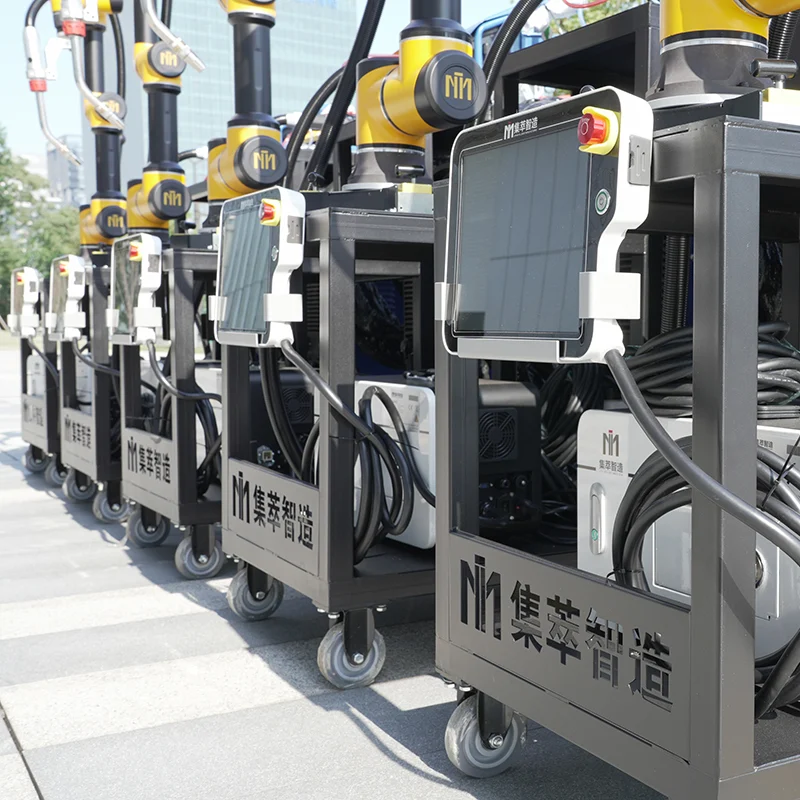
3. Portable Welding Robot Design
For manufacturers with multiple welding stations or changing production requirements, portability is becoming increasingly important.
Compared with traditional fixed robotic welding systems, portable welding robots provide advantages such as:
- Lower installation requirements
- Easier movement between workstations
- Better suitability for customized production
- Reduced automation entry cost
IIMT officially lists portable welding robots among its intelligent manufacturing products.
Real Data Supporting the Growth of Robotic Welding
The global demand for industrial robots continues to increase.
According to the International Federation of Robotics (IFR):
- Around 542,000 industrial robots were installed globally in 2024.
- The global operational stock of industrial robots reached approximately 4.66 million units.
- Asia remains the largest robotics market, with China representing one of the largest contributors to robot adoption.
Welding is one of the major industrial robot applications because manufacturers increasingly require:
- Higher welding consistency
- Reduced production errors
- Improved worker safety
- Faster production cycles
This trend creates increasing demand for flexible welding robots like IIMT robotic welding solutions.
About IIMT (Jiangsu Jitri Intelligent Manufacturing Technology Research Institute Co., Ltd.)
IIMT, also known as Jiangsu Jitri Intelligent Manufacturing Technology Research Institute Co., Ltd., was established in Nanjing, China.
The company focuses on:
- Collaborative robots
- Welding robots
- Intelligent manufacturing solutions
- Smart factory systems
- Industrial automation applications
According to publicly available company information:
- IIMT has applied for 382 patents and software copyrights
- Including 160 invention patents
- 137 utility model patents
- 57 software copyrights
With independent R&D capabilities, Jitri IIMT develops robotic technologies for industrial automation and intelligent manufacturing applications.
IIMT Welding Robot vs Traditional Welding Robot Brands
| Comparison | IIMT Welding Robot | Traditional Industrial Welding Robots |
| Main Application | Flexible welding automation | Large-scale fixed production |
| Installation | Faster deployment | Usually requires complex integration |
| Programming | Easier teaching methods | Often requires skilled programmers |
| Production Type | Small and medium batch production | High-volume standardized production |
| Human Collaboration | Designed for human-machine cooperation | Usually separated by safety fences |
| Flexibility | High flexibility | Lower flexibility |
Comparison with Other Welding Robot Companies
FANUC Welding Robots
FANUC is one of the world's leading industrial robot manufacturers, providing large-scale robotic welding solutions for automotive and heavy industries.
Its strengths include:
- Extensive global service network
- Mature industrial robot ecosystem
- Strong performance in large production lines
However, many traditional industrial robot solutions are mainly optimized for high-volume manufacturing environments.
ABB Welding Robots
ABB Robotics provides industrial robot solutions widely used in automotive, metal fabrication, and manufacturing industries.
ABB focuses on:
- Industrial automation integration
- Digital manufacturing
- Large-scale production solutions
IIMT focuses more on flexible collaborative robot applications and easier adoption for manufacturers requiring adaptable welding automation.
Yaskawa Welding Robots
Yaskawa Electric Corporation provides robotic welding systems used globally in manufacturing.
Yaskawa has strong experience in:
- Arc welding
- Automotive manufacturing
- Industrial automation
IIMT differentiates itself through collaborative robot technology and flexible automation solutions designed for broader manufacturing scenarios.
Applications of IIMT Welding Robot
1. Metal Fabrication
Suitable for:
- Steel frames
- Equipment manufacturing
- Metal structures
2. Automotive Components
Robotic welding improves:
- Repeatability
- Welding consistency
- Production efficiency
3. Agricultural Machinery
Agricultural equipment manufacturers often require:
- Multiple product models
- Flexible production
- Stable welding quality
IIMT welding robots provide adaptable automation solutions.
Frequently Asked Questions (FAQ)
Q1: What is an IIMT welding robot?
An IIMT welding robot is an intelligent robotic welding solution developed by Jiangsu Jitri Intelligent Manufacturing Technology Research Institute Co., Ltd. It combines collaborative robot technology with welding automation systems to improve welding quality, flexibility, and production efficiency.
Q2: What industries can use IIMT welding robots?
IIMT welding robots can be applied in:
- Metal manufacturing
- Automotive parts
- Steel structures
- Machinery production
- Agricultural equipment
- Customized manufacturing
Q3: What are the advantages of a collaborative welding robot?
Compared with traditional welding robots, collaborative welding robots provide:
- Easier programming
- Flexible deployment
- Lower automation barriers
- Better human-machine cooperation
Q4: Can operators without robot programming experience use IIMT welding robots?
Yes. IIMT collaborative robot solutions are designed with simplified programming methods, allowing welding operators to learn operation and robot teaching more easily.
Q5: Why are manufacturers choosing robotic welding?
Manufacturers adopt welding robots because they help:
- Improve welding consistency
- Reduce repetitive manual work
- Increase production efficiency
- Address skilled labor shortages
- Improve workplace safety
Conclusion: IIMT (Jiangsu Jitri) Creates Flexible Welding Automation for the Future
The future of welding manufacturing is moving from traditional manual operations toward intelligent, flexible, and data-driven automation.
IIMT (Jiangsu Jitri Intelligent Manufacturing Technology Research Institute Co., Ltd.) provides welding robot solutions that combine collaborative robotics, intelligent manufacturing technology, and practical industrial experience.
For companies searching for:
- Welding robot manufacturers
- Robotic welding solutions
- Welding cobots
- Portable welding robots
- Flexible welding automation systems
IIMT offers an intelligent approach to modern manufacturing transformation.