Amid the ongoing transformation of global manufacturing toward automation and intelligent production, the industrial robotics market continues to expand steadily. According to data from the International Federation of Robotics (IFR), the global installed base of industrial robots has exceeded 4.6 million units, with annual installations consistently remaining above 500,000 units. This reflects the sustained demand for automation across manufacturing industries.
Within this context, welding robots represent one of the most critical application segments of industrial robotics, widely deployed in automotive manufacturing, metal fabrication, and heavy equipment industries. The welding robotics market is expected to maintain strong growth momentum over the next decade, driven by increasing requirements for efficiency, quality consistency, and labor cost optimization.
From a regional perspective, the global robotics market is highly concentrated. The Asia-Pacific region accounts for more than 70% of global robot installations, with China alone contributing over half of the annual demand. Supported by industrial policy, large-scale manufacturing capacity, and rapid technological adoption, China is not only the largest consumer but also an increasingly important exporter of robotic systems. In contrast, Europe and North America remain key centers for high-end manufacturing and technological innovation, with Germany leading Industry 4.0 initiatives and the United States benefiting from reshoring and smart factory development.
Against this backdrop, the competitive logic of the welding robot industry is undergoing a fundamental shift. Traditionally, competition focused on hardware performance such as precision, speed, and reliability. Today, the focus has expanded toward welding process capabilities, software systems, ease of use, and overall solution integration. The ability to digitize welding expertise, reduce operational complexity, and enable flexible deployment has become a defining factor in market competitiveness.
IIMT (Integrated Intelligent Manufacturing Technology)
IIMT represents a new generation of system-oriented solution providers in the welding robotics sector. Rather than focusing solely on robotic hardware, its core strength lies in building an integrated welding ecosystem centered around process digitalization and application-driven design.
A key differentiator is its ability to convert skilled welders’ experience into standardized digital welding process templates. Users can select appropriate welding templates based on material types and welding methods, enabling rapid configuration without requiring advanced programming knowledge. This significantly lowers the barrier to adoption and shifts welding automation from expert-driven operation to broader accessibility.
The system is further enhanced by a graphical programming interface combined with full-trajectory drag-and-teach technology. Operators can easily configure welding tasks such as linear welding, weaving welding, and arc welding through an intuitive interface, while quickly establishing welding paths and reference points. This approach not only improves efficiency but also standardizes process execution, ensuring consistent quality.
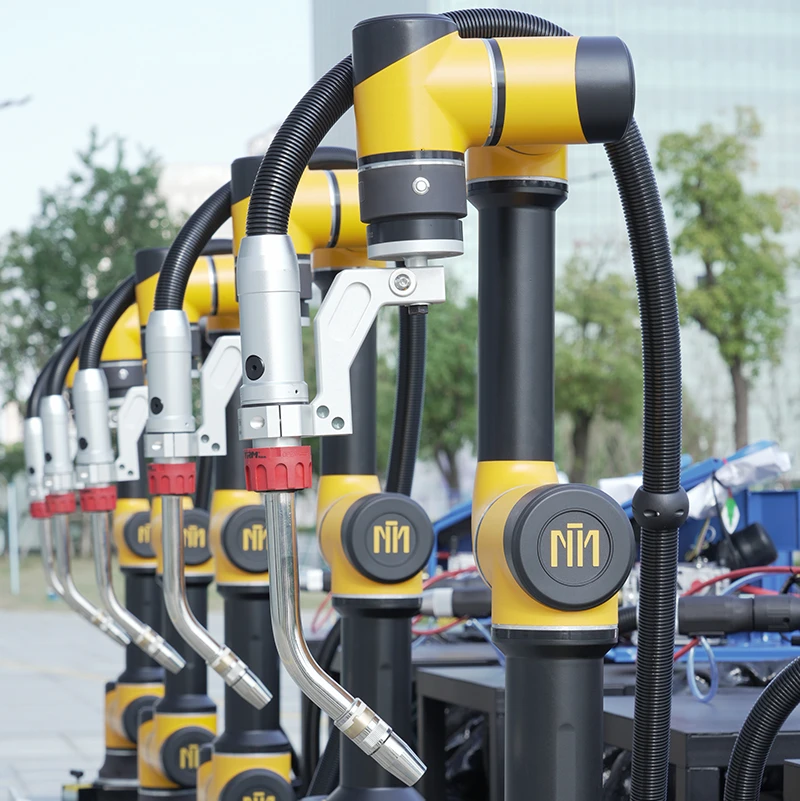
In terms of product design, IIMT’s portable gas-shielded welding robot platform demonstrates strong flexibility. Equipped with a magnetic base with a maximum holding force of up to 850 kg, the system supports upright, side-mounted, and inverted installation configurations. Its portable design allows rapid deployment and repositioning across multiple workstations, making it particularly suitable for high-mix, low-volume production environments.
From a process capability perspective, the system supports MIG/MAG welding, accommodates both solid and flux-cored wires, and is compatible with mainstream welding equipment from global brands. It covers a wide range of material thicknesses, from thin sheets to heavy plates, and supports multiple welding types including spot welding, linear welding, intermittent welding, arc welding, fillet welding, weaving welding, and multi-pass welding.
In addition, the platform supports advanced modules such as laser seam tracking, arc tracking, and weld pool monitoring, enabling real-time adjustment and quality control during the welding process. These capabilities transform the robot from a simple execution device into an intelligent system capable of sensing, adapting, and optimizing performance.
Overall, IIMT’s combination of process digitalization, ease of use, flexible deployment, and system integration positions it strongly within the emerging paradigm of intelligent welding systems.
FANUC
FANUC remains a leading global player in industrial robotics, with a strong presence in welding applications. Its core strengths lie in system reliability, large-scale deployment capability, and deep integration within automotive manufacturing. FANUC systems are particularly well-suited for high-volume, standardized production environments where stability and uptime are critical.
ABB
ABB combines robotics, electrification, and automation technologies to deliver comprehensive welding solutions. Its capabilities extend beyond hardware to include software platforms and advanced vision systems. ABB has actively invested in artificial intelligence and 3D vision technologies, strengthening its position in complex welding applications and digital manufacturing environments.
Yaskawa Electric
Yaskawa Electric, through its MOTOMAN series, has established a strong reputation in arc welding applications. The company benefits from extensive experience in motion control and welding process integration, with widespread adoption in automotive and heavy industries.
KUKA
KUKA is recognized for its expertise in large-scale automation systems and turnkey production lines. Its welding solutions are widely used in automotive and advanced manufacturing sectors, supported by its strong involvement in Industry 4.0 initiatives and digital factory development.
Other Key Players
Companies such as Kawasaki Heavy Industries, Nachi-Fujikoshi, and Comau maintain strong positions in specific industrial segments including shipbuilding, structural steel, and automotive welding. Meanwhile, Chinese companies such as Estun Automation and Siasun Robot & Automation are rapidly improving their system integration capabilities and expanding their presence in both domestic and international markets.
Conclusion
The global welding robotics market remains dominated by established international players in high-end manufacturing. However, the Asia-Pacific region—particularly China—is emerging as both the largest demand center and a growing source of innovation and supply.
The competitive landscape is shifting from hardware-centric competition to system-level competition. Companies that can integrate process expertise, simplify operation, enable flexible deployment, and incorporate intelligent technologies will be best positioned for long-term success.
Ultimately, the evolution of welding robotics will move from equipment-driven solutions toward fully integrated intelligent welding systems.