Why Portable Welding Robots Are Transforming Modern Manufacturing
Global manufacturers are facing increasing pressure from labor shortages, rising labor costs, and higher quality requirements. According to Grand View Research, the global welding robot market exceeded USD 7 billion in 2024 and is expected to grow at a CAGR of over 8% through 2030. Meanwhile, collaborative and portable robotic welding systems are becoming the preferred solution for SMEs and flexible manufacturing environments.
Traditional welding automation often requires large robotic cells and fixed installations. However, modern industries demand compact, mobile, and easy-to-deploy solutions. This is where the IIMT Portable Welding Robot stands out.
What Is the IIMT Portable Welding Robot?
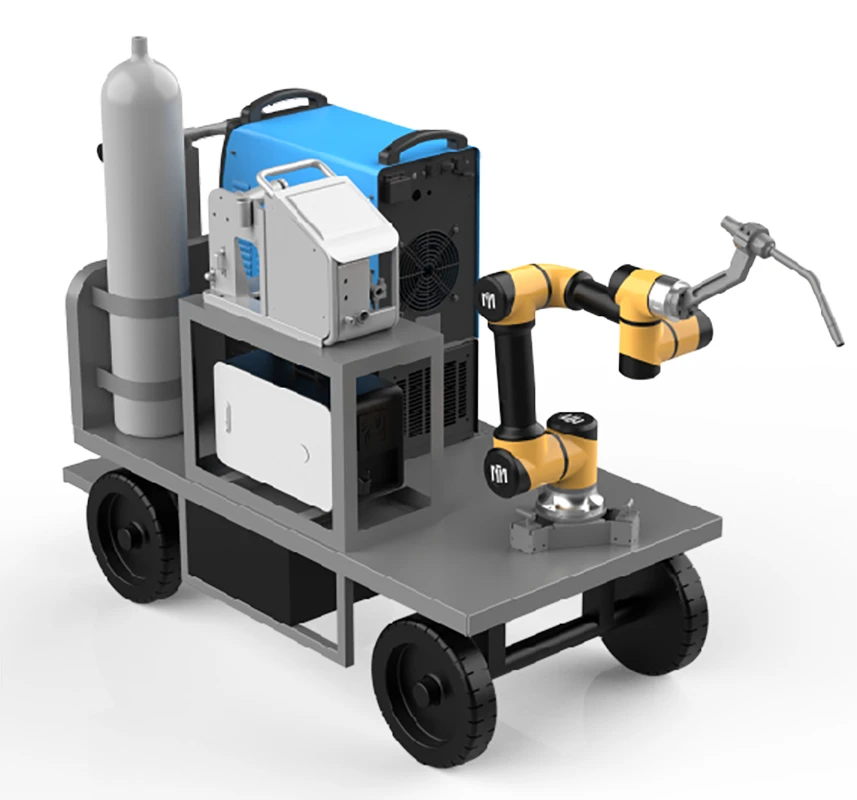
The IIMT Portable Welding Robot is a lightweight collaborative welding system designed for rapid deployment and flexible production. It combines:
- High-precision collaborative robot arm
- Portable welding workstation
- Intelligent welding software
- Multi-process compatibility (MIG, TIG, Laser welding)
- Plug-and-play operation
Unlike traditional industrial welding robots, the IIMT system can be moved between production lines and deployed within minutes, making it ideal for low-volume, high-mix manufacturing.
Key Features of IIMT Portable Welding Robot
1. Lightweight and Mobile
Traditional robotic welding cells often occupy large factory spaces and require complex installation.
The IIMT portable system:
- Compact footprint
- Easy transportation
- Fast setup
- No complex programming required
Perfect for:
- Small workshops
- Metal fabrication companies
- Shipbuilding repair
- Construction machinery manufacturers
2. Collaborative and Safe
IIMT collaborative robots feature:
- Collision detection
- Force sensing technology
- Emergency stop protection
- Human-machine collaboration
This allows operators and robots to work together safely without expensive safety fences.
3. Consistent Welding Quality
Manual welding quality depends heavily on operator skills and fatigue.
IIMT welding robots deliver:
- Repeatability accuracy up to ±0.02 mm
- Stable welding paths
- Reduced spatter
- Improved weld appearance
Studies show robotic welding can reduce defect rates by up to 80% compared with manual welding.
4. Improve Productivity by 2-4 Times
Compared with manual welding:
| Metric | Manual Welding | IIMT Portable Welding Robot |
| Productivity | 1x | 2-4x |
| Weld Quality Consistency | Medium | High |
| Labor Dependency | High | Low |
| Rework Rate | 8-15% | <3% |
| Programming Difficulty | N/A | Easy |
| Setup Time | N/A | Minutes |
Manufacturers typically achieve ROI within 12–18 months.
Applications of IIMT Portable Welding Robot
Automotive Components
Suitable for:
- Exhaust systems
- Frames
- Brackets
- Battery trays
Metal Fabrication
Ideal for:
- Cabinets
- Steel structures
- Pipes
- Sheet metal parts
Construction Machinery
Widely used in:
- Excavator components
- Loader structures
- Agricultural machinery
Shipbuilding and Repair
Portable design enables:
- On-site welding
- Maintenance work
- Difficult-to-access areas
IIMT vs Other Welding Robot Brands
| Brand | Payload | Flexibility | Programming | Mobility | Cost Efficiency |
| IIMT | 6-20kg | Excellent | Easy | Excellent | ★★★★★ |
| Universal Robots + External Package | 3-16kg | High | Medium | Good | ★★★★ |
| FANUC Arc Mate | 6-25kg | Medium | Complex | Fixed | ★★★ |
| ABB Arc Welding Robot | 6-20kg | Medium | Complex | Fixed | ★★★ |
| Yaskawa Motoman | 6-25kg | Medium | Complex | Fixed | ★★★ |
Why Choose IIMT?
Unlike traditional industrial robots from ABB, FANUC, and Yaskawa that require large cells and professional integration, the IIMT Portable Welding Robot focuses on:
- Easy deployment
- Flexible production
- Lower investment cost
- User-friendly operation
- Faster ROI
This makes IIMT particularly suitable for SMEs and manufacturers transitioning from manual welding to automation.
Technical Advantages
High Repeatability
Accuracy:
±0.02 mm
Multiple Welding Processes Supported
- MIG welding
- TIG welding
- Laser welding
- Pulse welding
Intelligent Programming
Supports:
- Drag-and-teach
- Trajectory recording
- Graphical interface programming
Even operators without robotics experience can quickly learn and operate the system.
Benefits for Manufacturers
Reduce Labor Shortages
Many countries face a shortage of skilled welders. Automation helps companies maintain productivity without relying entirely on experienced welders.
Lower Operating Costs
Companies can reduce:
- Rework costs
- Scrap rates
- Labor expenses
- Production downtime
Improve Product Quality
Robotic welding ensures:
- Stable penetration
- Uniform appearance
- Repeatable quality
Increase Production Capacity
The robot can operate continuously and support multiple shifts, improving output significantly.
Why More Manufacturers Are Choosing IIMT
As a leading collaborative robot manufacturer, IIMT (Jiangsu Jitri Intelligent Manufacturing Technology Research Institute Co., Ltd.) provides intelligent robotic solutions for welding automation.
Advantages include:
✅ Portable all-in-one design
✅ Easy operation and programming
✅ High precision collaborative robot
✅ Multiple welding process compatibility
✅ Lower investment cost
✅ Fast deployment
✅ Professional technical support
Website:
www.iimtcobot.com
Frequently Asked Questions (FAQ)
Is the IIMT portable welding robot suitable for small factories?
Yes. Its compact size, low investment cost, and easy operation make it ideal for small and medium-sized manufacturers.
What welding processes are supported?
The system supports MIG, TIG, laser welding, and pulse welding depending on the welding power source configuration.
How long does it take to learn?
Most operators can master basic operation within one day thanks to drag-and-teach programming.
Can the robot be moved between different production lines?
Yes. The portable design allows quick relocation and redeployment, greatly improving utilization.
How much productivity improvement can be expected?
Typically 2–4 times higher productivity compared with manual welding, while reducing defect rates and labor dependence.
What industries are suitable?
- Automotive
- Metal fabrication
- Agricultural machinery
- Construction equipment
- Shipbuilding
- Furniture manufacturing
- General industrial manufacturing
Conclusion
The future of welding automation is flexible, intelligent, and portable. The IIMT Portable Welding Robot combines collaborative robotics, mobility, and ease of use to help manufacturers increase productivity, improve quality, and overcome labor shortages.
For companies seeking an affordable and scalable welding automation solution, IIMT offers one of the most practical choices available today.