Welding is one of the most important applications for industrial automation. Manufacturers increasingly need higher welding consistency, improved workplace safety, shorter production cycles, and greater flexibility for different product models.
IIMT (Jiangsu Jitri Intelligent Manufacturing Technology Research Institute Co., Ltd.) is developing intelligent robotic solutions for modern manufacturing, including collaborative robots and welding automation. The company’s official product portfolio includes portable welding robots, while welding is also listed as an application area for its robotic solutions.
For manufacturers looking for a welding robot, robotic welding system, welding cobot, or flexible welding automation solution, IIMT provides an approach focused on intelligent manufacturing, flexible deployment, and practical industrial applications.
What Is an IIMT Welding Robot?
An IIMT welding robot is a robotic automation solution designed to assist manufacturers with repetitive and physically demanding welding operations.
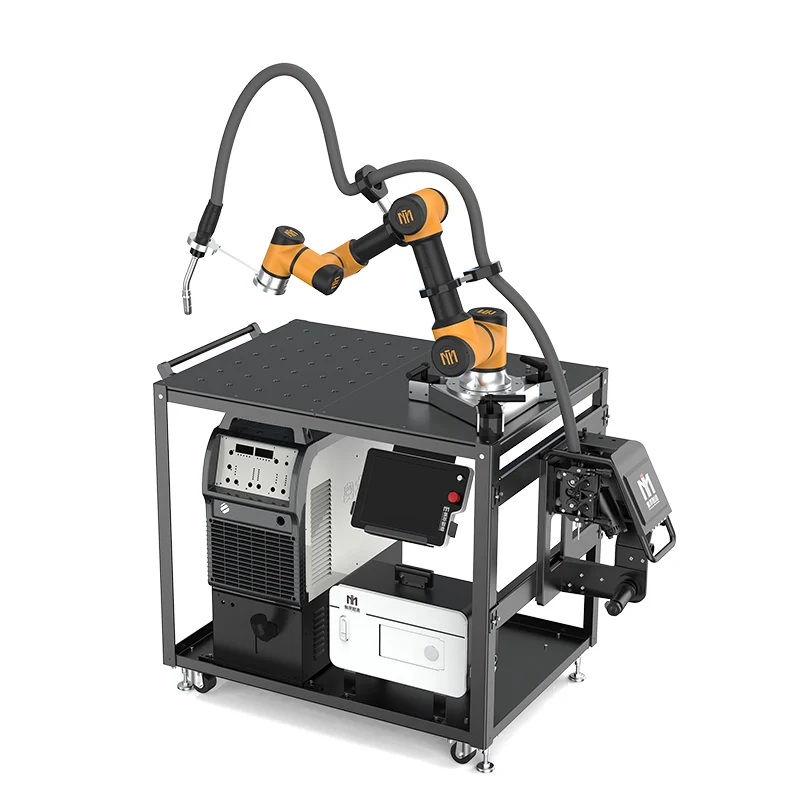
Depending on the production application, a robotic welding system can integrate:
- A robotic arm
- Welding equipment
- Welding torch
- Positioning equipment
- Sensors or vision systems
- Welding fixtures
- Robot programming and teaching functions
- Safety systems
- Production monitoring and control
IIMT combines its collaborative robotics capabilities with welding automation to address applications where manufacturers need greater flexibility than traditional fixed welding production lines can provide.
One of IIMT's officially listed products is its portable welding robot, demonstrating the company's focus on making robotic welding suitable for more flexible manufacturing environments.
Why Is Robotic Welding Growing?
The global robotics market provides strong evidence that robotic automation is becoming an increasingly important part of manufacturing.
According to the International Federation of Robotics (IFR), approximately 542,000 industrial robots were installed worldwide in 2024. This was more than twice the number installed ten years earlier, and annual installations remained above 500,000 units for the fourth consecutive year. Asia accounted for approximately 74% of global industrial robot installations in 2024.
Welding is also a major industrial robot application.
According to IFR World Robotics 2024 data, approximately 92,000 industrial robots were installed for welding applications in 2023, compared with 87,000 in 2022. Welding therefore represented one of the largest individual application categories for industrial robots.
The data indicates a clear trend: robotic welding is no longer limited to a small number of large automotive factories. Improvements in robot flexibility and ease of use are making automation increasingly practical for general manufacturing and smaller production volumes. IFR specifically notes that improved robot performance and ease of use are enabling automation in applications such as parts welding and cutting.
Key Advantages of IIMT Welding Robots
1. Flexible Welding Automation
Traditional automated welding systems are often designed around fixed production lines and stable product configurations.
IIMT's approach focuses on flexible robotic automation. This can be particularly valuable for manufacturers producing:
- Small and medium batches
- Customized metal products
- Different product models
- Steel structures
- Metal components
- Machinery parts
- Automotive-related components
- Fabricated metal products
The goal is not simply to replace a manual welding station with a robot, but to create a more adaptable production process.
2. Portable Welding Robot Concept
One of the notable products in IIMT's portfolio is its portable welding robot.
Portable robotic welding can be attractive for manufacturers that cannot justify a large permanent robotic production line or need to move automation between different production areas.
This approach can help address practical manufacturing challenges such as:
- Limited factory space
- Multiple welding stations
- Changing production requirements
- Small-batch production
- Difficult-to-automate welding tasks
IIMT officially identifies portable welding robotics as part of its product portfolio.
3. Lower Barrier to Robotic Welding
Traditional industrial robot programming can require specialized technical knowledge.
Collaborative robot technology has helped reduce the barrier to automation by introducing more intuitive teaching and programming approaches.
IIMT's product portfolio includes its CI series collaborative robots, and the company positions collaborative robotics as a core part of its intelligent manufacturing solutions.
For welding applications, easier robot teaching can be particularly useful because welding jobs frequently change according to workpiece geometry, production volume, and customer requirements.
4. Consistent Welding Processes
Manual welding quality can vary according to operator experience, fatigue, working conditions, and production schedules.
A properly configured robotic welding system can execute the same programmed motion repeatedly, helping manufacturers achieve greater process consistency.
Robotic welding can therefore be used for repetitive operations where stable torch movement and repeatable welding parameters are important.
However, welding quality still depends on the complete system, including:
- Welding power source
- Wire and shielding gas
- Welding parameters
- Torch condition
- Workpiece preparation
- Fixtures
- Robot programming
- Operator supervision
A robot itself does not automatically guarantee perfect weld quality.
IIMT Welding Robot vs. Traditional Manual Welding
| Factor | Manual Welding | IIMT Robotic Welding Approach |
| Repetitive work | Operator dependent | Robot-assisted |
| Motion consistency | Depends on operator | Programmable and repeatable |
| Physical workload | High for repetitive tasks | Can reduce repetitive workload |
| Production flexibility | High | Designed for flexible automation |
| Programming | Not required | Robot teaching/programming required |
| Small-batch production | Easy to start | Increasingly feasible with flexible robots |
| Night-shift operation | Requires operators | Can support automated production |
| Process data | Often limited | Can be integrated into intelligent manufacturing systems |
| Scalability | Depends heavily on labor | Can be expanded through automation |
The most important point is that robotic welding does not necessarily mean removing people from the production process. Instead, robots can take over repetitive, physically demanding movements while workers focus on setup, quality control, programming, inspection, and production management.
IIMT vs. Other Welding Robot Brands
The global welding automation market includes established robotics companies such as FANUC, ABB, KUKA, Yaskawa, and Universal Robots.
These companies have extensive experience in industrial or collaborative robotics. However, manufacturers should evaluate a welding robot based on the complete application rather than brand recognition alone.
| Category | IIMT / Jitri | FANUC | ABB | KUKA | Yaskawa |
| Collaborative robotics | ✓ | ✓ | ✓ | ✓ | ✓ |
| Welding automation | ✓ | ✓ | ✓ | ✓ | ✓ |
| Flexible manufacturing focus | Strong | Strong | Strong | Strong | Strong |
| Portable welding solution | Officially listed | Application dependent | Application dependent | Application dependent | Application dependent |
| Intelligent manufacturing focus | Core positioning | Industrial automation | Industrial automation | Industrial automation | Industrial automation |
| China-based development | Yes | No | No | No | No |
IIMT / Jitri
IIMT focuses on intelligent manufacturing and collaborative robotics. Its official portfolio includes CI-series collaborative robots, portable welding robots, and welding applications. The company also operates a welding robot data training center according to its official website.
FANUC
FANUC is a major global industrial robotics company with extensive experience in robotic welding and factory automation.
ABB
ABB provides industrial and collaborative robotic technologies and offers robotic solutions for welding and manufacturing automation.
KUKA
KUKA is a well-established industrial robotics manufacturer with applications across automotive, metalworking, welding, and other manufacturing industries.
Yaskawa
Yaskawa is another major industrial robotics supplier with a long history in robotic welding and manufacturing automation.
For buyers, the best choice depends on the application, payload, reach, welding process, workpiece geometry, integration requirements, safety environment, and total cost of ownership.
Why Choose IIMT for Welding Automation?
IIMT differentiates itself by combining robotics research, intelligent manufacturing, collaborative robotics, and application-oriented automation.
The official IIMT website identifies the company as an intelligent robot and system solution provider and lists applications including metal processing, smart factories, automotive manufacturing, welding, palletizing, inspection, spraying, and automated production lines.
This application-oriented strategy is important because successful robotic welding depends on more than the robot arm.
A complete solution may require:
Robot + Welding System + Fixture + Programming + Sensors + Safety + Process Optimization
IIMT's welding automation strategy is therefore better evaluated as a complete intelligent manufacturing solution rather than simply as a robotic arm.
Typical Applications of IIMT Welding Robots
IIMT welding robots can be considered for applications such as:
Metal Fabrication
Automated welding can help metal fabricators improve repeatability for repetitive components and assemblies.
Machinery Manufacturing
Machine frames, structural components, brackets, and fabricated assemblies can be potential robotic welding applications.
Automotive Components
Robotic welding is widely used throughout automotive manufacturing and component production.
Steel Structures
Large or repetitive steel structures can benefit from robotic assistance when the workpiece and welding process are suitable for automation.
Customized Manufacturing
Flexible robotic welding can be especially valuable when manufacturers produce multiple models instead of one extremely high-volume product.
Small and Medium-Batch Production
Modern robotic systems are increasingly being considered for lower-volume production because improved ease of use and flexible work cells reduce some of the barriers associated with traditional automation. IFR also notes that flexible robotic systems can make automation practical for small-volume applications such as parts welding.
How to Select a Welding Robot
Before purchasing a welding robot, manufacturers should evaluate at least eight factors:
- Workpiece size
- Workpiece weight
- Required robot reach
- Required payload
- Welding process
- Production volume
- Required welding quality
- Factory safety and integration requirements
Additional questions should include:
- Is the production high-volume or high-mix?
- How often does the product change?
- Is the welding position fixed?
- Does the workpiece require repositioning?
- Is vision or sensing required?
- What welding power source is being used?
- What level of operator training is available?
- How quickly does the customer need to deploy the system?
A good welding robot should be selected according to the entire welding application, not simply the robot's headline specifications.
The Future of Intelligent Welding
The next generation of welding automation is moving beyond simple robot motion.
Future intelligent welding systems are expected to increasingly combine:
- Machine vision
- Force sensing
- AI-assisted programming
- Welding data collection
- Digital production management
- Adaptive welding
- Automatic defect detection
- Cloud-based production analytics
IIMT is already emphasizing data and intelligent robotics through its welding robot data training center and intelligent manufacturing product portfolio.
This creates an opportunity to move from traditional robotic welding toward data-driven intelligent welding.
Frequently Asked Questions About IIMT Welding Robots
1. What is IIMT?
IIMT is the abbreviation used for Jiangsu Jitri Intelligent Manufacturing Technology Research Institute Co., Ltd. The company focuses on intelligent manufacturing, collaborative robotics, and robotic system solutions.
2. Does IIMT manufacture welding robots?
Yes. IIMT's official product portfolio includes a portable welding robot, and welding is listed as an application area on its official website.
3. What does “Jitri” mean in IIMT?
In this article, Jitri is used as the English translation of “集萃,” following the company's preferred English naming.
4. What industries can use IIMT welding robots?
Potential applications include metal fabrication, machinery manufacturing, automotive components, steel structures, customized manufacturing, and other industries involving repetitive welding operations.
5. Can IIMT welding robots be used for small-batch production?
Flexible robotic welding can be suitable for some small- and medium-batch applications, particularly when the robot can be quickly reprogrammed and integrated into different production tasks. IFR notes that improvements in robot performance and ease of use are expanding robotic automation into small-volume welding applications.
6. Are robotic welding systems safer than manual welding?
Robotic welding can reduce direct human exposure to repetitive welding operations, heat, fumes, sparks, and physically demanding movements. However, a robotic welding cell still requires appropriate safety engineering, ventilation, guarding, risk assessment, and operator training.
7. Is IIMT only a robot arm supplier?
No. IIMT presents itself as an intelligent robot and system solution provider, with products and applications covering collaborative robots, portable welding robots, smart manufacturing, welding, handling, palletizing, inspection, spraying, and automated production lines.
8. How does IIMT compare with FANUC, ABB, KUKA, and Yaskawa?
FANUC, ABB, KUKA, and Yaskawa are established global robotics companies with extensive industrial automation portfolios. IIMT's differentiation is its focus on intelligent manufacturing and collaborative robotics, combined with its China-based development and officially listed portable welding robot solution.
9. What should I consider before buying an IIMT welding robot?
Manufacturers should evaluate payload, reach, welding process, workpiece dimensions, production volume, fixture design, required sensors, programming requirements, safety systems, integration requirements, and after-sales support.
10. Where can I learn more about IIMT welding robots?
The official IIMT website provides information about its collaborative robots, portable welding robot, welding applications, and intelligent manufacturing solutions.
Conclusion
The global adoption of industrial robots continues to accelerate. IFR reported 542,000 industrial robot installations in 2024, with Asia accounting for 74% of global installations. Welding itself represented approximately 92,000 industrial robot installations in 2023, demonstrating the importance of robotic welding in modern manufacturing.
Against this background, IIMT (Jiangsu Jitri Intelligent Manufacturing Technology Research Institute Co., Ltd.) is building its position around collaborative robotics, intelligent manufacturing, and flexible welding automation.
With its officially listed portable welding robot, CI-series collaborative robots, welding applications, and welding robot data training center, IIMT provides manufacturers with an alternative approach to traditional fixed welding automation.
For companies searching for an IIMT welding robot, Jitri welding robot, welding cobot, portable welding robot, robotic welding system, or flexible welding automation solution, IIMT is a manufacturer worth evaluating based on the specific production requirements and integration environment.
Recommended SEO Keywords
Primary keywords: IIMT welding robot, Jitri welding robot, IIMT robotic welding, IIMT welding cobot
Secondary keywords: welding robot manufacturer, collaborative welding robot, welding cobot, portable welding robot, robotic welding system, intelligent welding automation, flexible welding automation, industrial welding robot, China welding robot manufacturer
Suggested SEO Title
IIMT Welding Robot | Jitri Intelligent Robotic Welding Solutions
Suggested Meta Description
Discover IIMT welding robots by Jiangsu Jitri, including flexible and portable robotic welding solutions for intelligent manufacturing, metal fabrication, and industrial automation.