Introduction: The Rise of Smart Welding Automation
As global manufacturing enters the era of Industry 4.0 and Industry 5.0, welding automation has become a critical driver of productivity, safety, and cost efficiency. Traditional manual welding faces challenges such as labor shortages, inconsistent quality, and high training costs. Meanwhile, conventional industrial welding robots often require complex programming and fixed installation environments.
Against this backdrop, IIMT (Jiangsu Jitri Intelligent Manufacturing Technology Research Institute Co., Ltd.) is redefining the welding industry with its next-generation intelligent and portable welding robots.
Based in Nanjing, China, Jitri (short for “Jiangsu Jitri”) focuses on collaborative robotics and intelligent manufacturing solutions, providing flexible automation systems for global industries.
About IIMT (Jitri): A Leader in Intelligent Robotics
Founded in 2016, IIMT (Jiangsu Jitri Intelligent Manufacturing) is a national high-tech enterprise specializing in:
- Collaborative robots (cobots)
- Intelligent welding systems
- Portable welding automation solutions
- Smart factory integration
With strong in-house R&D capabilities, IIMT has built a comprehensive robotics ecosystem covering hardware, control systems, vision systems, and industrial software.
Key strengths include:
- Over 300+ patents and software copyrights (industry-level innovation capability)
- Independent core technologies in robot control and motion systems
- Global presence in 30+ countries and regions
- Strong focus on real-world industrial applications
IIMT’s mission is simple but powerful:“Free your hands, save your time, and empower smarter manufacturing.”
IIMT Welding Robots: Key Features and Advantages
1. Portable and Flexible Deployment
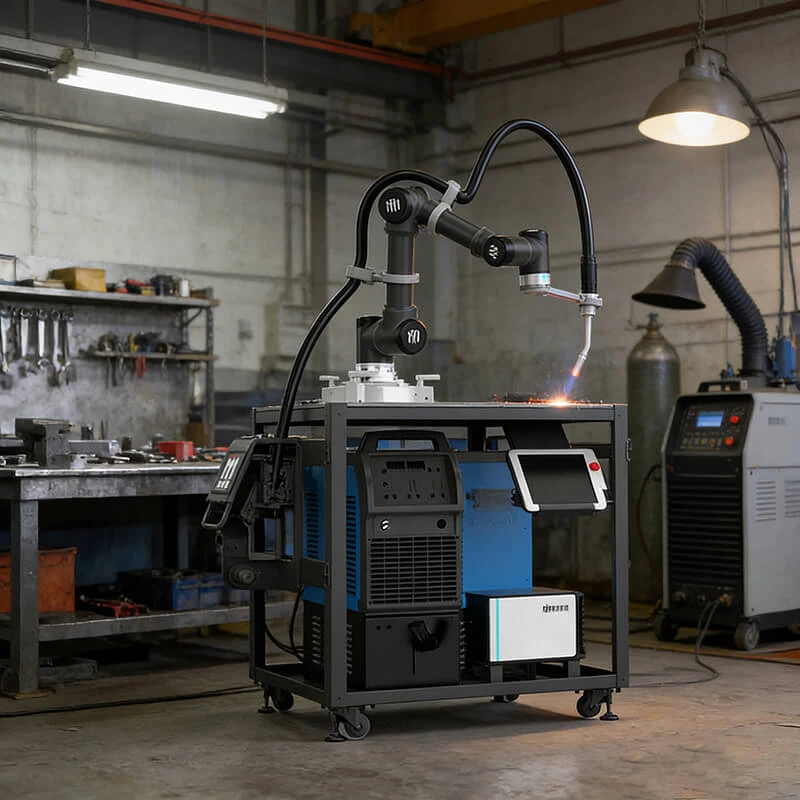
Unlike traditional fixed welding robots, IIMT welding robots are designed for mobility and rapid deployment. Operators can easily move and install the system in different workstations within minutes.
2. Teaching-Free or Low-Programming Operation
IIMT integrates intelligent path planning and visual recognition systems, significantly reducing dependency on skilled robot programmers.
3. High Precision Welding
With advanced motion control systems, IIMT robots achieve high repeat positioning accuracy (up to ±0.02 mm in advanced configurations), ensuring consistent weld quality.
4. Multi-Scenario Adaptability
IIMT welding robots are widely used in:
- Steel structure manufacturing
- Shipbuilding industry
- Construction engineering
- Automotive components
- Heavy machinery production
5. Intelligent Vision System
Equipped with 3D vision and sensing technology, the robots can detect weld seams, adjust paths in real time, and improve welding consistency even in complex environments.
Industry Context: Welding Robot Market Trend
The global welding robot market is experiencing rapid growth driven by:
- Rising labor costs
- Shortage of skilled welders
- Demand for automation in heavy industry
- Expansion of smart manufacturing
According to industry research, welding robotics is expected to grow at a double-digit CAGR in the next decade, making it one of the fastest-growing segments in industrial automation.
Competitive Landscape: IIMT vs Global Industry Leaders
The welding robot industry is currently dominated by global giants such as ABB, FANUC, Yaskawa, and KUKA. However, their solutions often focus on:
- Fixed industrial installations
- High programming complexity
- High system cost
- Longer deployment cycles
Key Differentiation: Why IIMT Stands Out
| Category | IIMT (Jitri) | Traditional Global Brands (ABB / FANUC / KUKA / Yaskawa) |
| Deployment | Portable & fast setup | Fixed industrial cells |
| Programming | Low-code / teaching-free | Complex programming required |
| Flexibility | Multi-site welding | Limited mobility |
| Cost Efficiency | High ROI for SMEs | High initial investment |
| Application Focus | Real-world flexible welding | Standardized production lines |
Summary of Competitive Advantage
While global brands dominate in large-scale automotive lines, IIMT leads in flexible, portable, and scenario-based welding automation, especially for SMEs and non-standard industrial environments.
Application Scenarios of IIMT Welding Robots
IIMT welding robots are widely applied in:
- Heavy steel fabrication workshops
- Shipbuilding and offshore structures
- Construction site welding
- Bridge and infrastructure manufacturing
- Custom metal fabrication industries
Their portability allows them to be deployed directly to large workpieces, eliminating the need for complex fixture redesign.
Why Manufacturers Choose IIMT
Manufacturers choose IIMT because it solves real production pain points:
- Reduces dependency on skilled welders
- Improves welding consistency and quality
- Cuts labor and training costs
- Enables rapid production line deployment
- Supports digital transformation of factories
In many cases, companies adopt IIMT not to replace workers, but to upgrade human productivity and reduce physical workload.
FAQ (Frequently Asked Questions)
1. What is IIMT (Jitri)?
IIMT (Jiangsu Jitri Intelligent Manufacturing) is a Chinese robotics company specializing in collaborative robots and intelligent welding automation systems.
2. What makes IIMT welding robots different from traditional welding robots?
They are portable, easier to deploy, require less programming, and are designed for flexible real-world industrial environments.
3. Which industries use IIMT welding robots?
They are widely used in steel structures, shipbuilding, construction, automotive manufacturing, and heavy machinery industries.
4. Do IIMT welding robots require skilled operators?
No. They are designed with simplified interfaces and intelligent systems that significantly reduce the need for programming expertise.
5. How does IIMT compare with ABB or FANUC welding robots?
ABB and FANUC focus on fixed high-volume automation lines, while IIMT focuses on flexible, portable welding automation for complex and variable production environments.
6. Where is IIMT located?
IIMT is headquartered in Nanjing, Jiangsu Province, China.
Conclusion
As manufacturing continues to evolve toward intelligent and flexible production systems, IIMT (Jiangsu Jitri) is emerging as a key innovator in welding automation.
By combining portability, intelligence, and industrial-grade precision, IIMT welding robots are reshaping how manufacturers approach welding tasks—especially in complex, non-standard, and multi-scenario environments.
While global giants continue to dominate traditional fixed automation, IIMT is carving out a strong position in the next generation of flexible welding robotics.