1. What Is a Welding Robot Training Workstation?
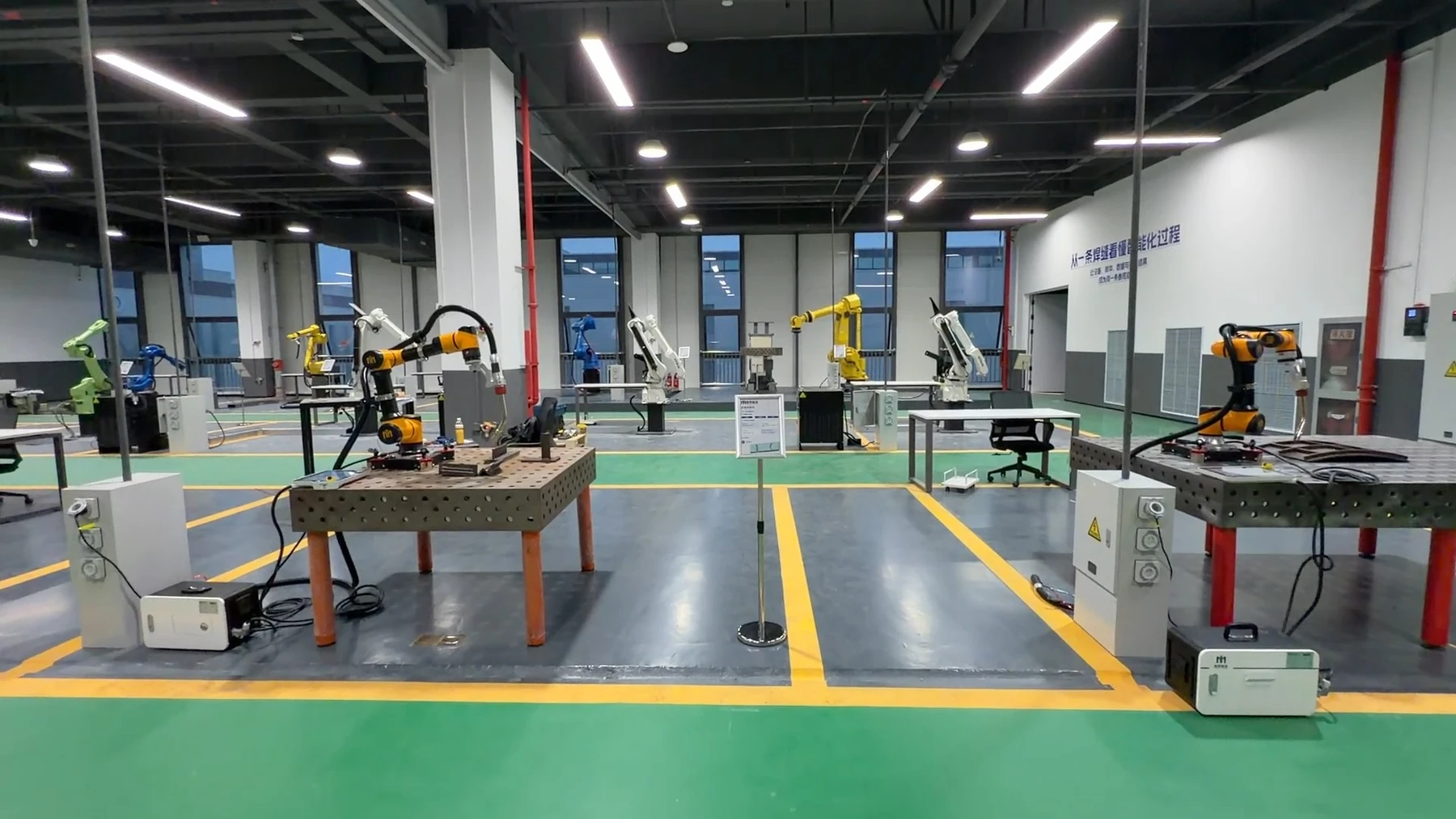
A welding robot training workstation is an educational and technical training system designed to help students, instructors, engineers, and automation professionals develop practical skills in robotic welding.
Unlike traditional welding training equipment that focuses primarily on manual welding techniques, a robotic welding training workstation can provide hands-on learning opportunities in robot programming, coordinate systems, motion control, welding process fundamentals, tool calibration, and automated welding workflows.
The JITRI Welding Robot Training Workstation, developed and supplied by Jiangsu Jitri Intelligent Manufacturing Technology Research Institute Co., Ltd. (IIMT), is positioned for the growing need to connect robotics education with practical industrial automation skills.
Depending on the selected configuration, a welding robot training workstation can be designed around:
- Industrial or collaborative robot operation
- Robot teaching and trajectory programming
- Welding torch movement and workpiece positioning
- Welding process demonstrations
- Welding parameter fundamentals
- Robot calibration and coordinate system training
- Basic troubleshooting and maintenance education
- Automated welding application demonstrations
The actual equipment configuration, supported welding processes, robot payload, reach, and software functions should be confirmed against the specific JITRI model and technical datasheet.
2. Why Is Robotic Welding Training Becoming More Important?
Industrial robotics is playing an increasingly important role in modern manufacturing. As factories adopt automation, the demand for professionals who understand robot operation, programming, integration, and process optimization is becoming more significant.
According to the International Federation of Robotics (IFR), its World Robotics 2025 report recorded approximately 542,000 industrial robot installations worldwide in 2024, more than double the number installed ten years earlier.
The IFR also reported that Asia accounted for 74% of new industrial robot installations in 2024, highlighting the region's importance in global industrial automation.
These figures describe the industrial robotics market, not the welding training equipment market. Nevertheless, they demonstrate the expanding industrial environment in which practical robotics education can deliver value.
For educational institutions, the challenge is not simply introducing students to robots. It is helping them understand how robotic systems work in real manufacturing environments.
A structured welding robot training workstation can help learners build a foundation in:
- Robot movement and programming logic.
- Welding process principles and process variables.
- Workpiece positioning and fixture concepts.
- Automation system safety.
- Production-oriented problem-solving.
Source: International Federation of Robotics, World Robotics 2025.https://ifr.org/P53
3. JITRI Welding Robot Training Workstation: Connecting Robotics Education with Industry
JITRI, short for Jiangsu Jitri Intelligent Manufacturing Technology Research Institute Co., Ltd. (IIMT), focuses on intelligent manufacturing technologies and robotic solutions.
For institutions seeking welding robot training equipment, the value of a training workstation lies in the connection between robotic hardware, programming education, welding technology, and real application scenarios.
A well-designed JITRI welding robot training solution can support several educational objectives.
3.1 Robot Programming and Teaching
Robot programming is one of the fundamental skills required for industrial automation.
Training exercises may include:
- Understanding robot coordinate systems.
- Learning joint and Cartesian motion.
- Creating and modifying robot motion paths.
- Teaching waypoints for welding trajectories.
- Understanding approach, welding, and retreat movements.
- Practicing program verification and controlled testing.
These exercises can help learners understand how programmed movements translate into physical robotic operations.
3.2 Robotic Welding Process Fundamentals
Automated welding requires coordination between robot motion and welding process conditions.
Training content may include:
- Welding torch orientation.
- Welding speed and travel path.
- Workpiece positioning.
- Welding current and voltage concepts.
- Wire feed speed and shielding gas fundamentals, where applicable.
- Weld quality inspection and defect identification.
- The relationship between process parameters and weld outcomes.
For example, changing the travel speed or torch angle may influence weld formation. Students can study these relationships through controlled experiments under instructor supervision.
Actual welding exercises require compatible welding equipment, appropriate consumables, workpieces, and suitable safety provisions.
3.3 Fixture Design and Workpiece Positioning
Welding accuracy depends not only on robot programming but also on consistent workpiece positioning.
Training exercises can introduce:
- Basic fixture design.
- Workpiece reference points.
- Tool center point (TCP) concepts.
- Coordinate calibration.
- Repeatable loading and positioning.
- Welding path consistency.
These concepts are relevant to automotive components, metal fabrication, machinery manufacturing, and other welding applications.
3.4 Automation Integration Fundamentals
For advanced training programs, a workstation may be configured to demonstrate broader automation concepts.
Depending on available hardware and integration scope, these may include:
- Robot and welding power source communication.
- Digital input/output signals.
- Safety interlocks.
- Basic PLC integration.
- Workpiece detection.
- Production sequence logic.
- Fault diagnosis and recovery procedures.
These capabilities should be treated as optional training modules unless they are explicitly included in the purchased configuration.
4. Who Can Benefit from a Welding Robot Training Workstation?
The JITRI welding robot training workstation concept is relevant to organizations developing practical automation capabilities.
Vocational Colleges and Technical Schools
Vocational education institutions can use robotic welding training equipment to introduce students to modern manufacturing technologies.
Potential training programs include:
- Industrial robot operation.
- Robotic welding fundamentals.
- Welding automation technology.
- Robot programming.
- Intelligent manufacturing.
Universities and Engineering Laboratories
Universities can incorporate robotic welding workstations into engineering education, applied research, and automation laboratories.
Potential activities include motion planning demonstrations, welding trajectory experiments, process studies, and robot system integration projects.
Industrial Training Centers
Technical training centers can use robotic welding equipment to support structured operator and technician training.
Training objectives may include basic robot operation, program adjustment, troubleshooting, and production process understanding.
System Integrators and Manufacturing Companies
Automation integrators can use suitable training configurations for internal skills development, demonstration, and preliminary application testing.
For manufacturers, training can help employees understand the transition from manual welding operations to robot-assisted production processes.
5. What Should Buyers Look for in Welding Robot Training Equipment?
When evaluating a welding robot training workstation, buyers should assess both the robot itself and the complete training environment.
| Evaluation Factor | What to Check |
| Robot configuration | Robot type, axes, payload, reach |
| Programming | Teaching methods, software, programming interface |
| Welding capability | Supported welding processes and compatible power sources |
| Training functions | Curriculum support, demonstration modes, exercises |
| Safety | Risk assessment, guarding, interlocks, emergency stop |
| Expandability | PLC, sensors, fixtures, optional equipment |
| Maintenance | Technical documentation, spare parts, service support |
| Installation | Training, commissioning, acceptance criteria |
A robot's repeatability specification alone is not sufficient to establish the achievable welding accuracy or finished weld quality.
Actual results depend on the complete system, including robot characteristics, calibration, fixtures, welding process conditions, workpiece tolerances, and system integration.
6. Welding Robot Training Workstation vs. Traditional Welding Training
Traditional welding training and robotic welding training serve different but complementary purposes.
| Training Aspect | Traditional Welding Training | Robotic Welding Training |
| Main focus | Manual welding skills | Robot operation and automated welding |
| Core skills | Torch handling, weld technique | Programming, motion, process integration |
| Process understanding | Essential | Essential |
| Automation | Usually limited | Central learning objective |
| Career preparation | Welding operators | Robot technicians, automation engineers, robotic welding operators |
A comprehensive technical education program can combine both approaches.
Students who understand welding fundamentals and robotic automation may be better prepared to work in manufacturing environments where manual expertise and automation skills complement each other.
7. Safety Considerations for Robotic Welding Training
Safety must be an integral part of robotic welding education.
Robotic welding can involve multiple hazards, including:
- Robot motion and collision risks.
- Welding arc radiation.
- Hot workpieces and spatter.
- Welding fumes and gases.
- Electrical hazards.
- Fire hazards.
- Gas cylinder handling risks.
The international safety framework includes ISO 10218-1:2025, covering industrial robot safety requirements, and ISO 10218-2:2025, covering the safety of industrial robot applications and robot cells.
ISO 10218-2 addresses areas such as integration, commissioning, operation, maintenance, and repair.
Importantly, a training workstation should not be assumed safe merely because it uses a collaborative robot or is marketed for education.
The complete application must be assessed, including the welding process, tooling, workpieces, safeguarding, operating procedures, and the intended user environment.
Recommended safety provisions may include:
- Application-specific risk assessment.
- Suitable physical guarding or validated protective measures.
- Emergency stop functions.
- Safety-rated interlocking where required.
- Appropriate welding screens.
- Fume extraction and ventilation.
- Personal protective equipment.
- Instructor supervision and operating procedures.
The applicable local regulations and standards should be verified before installation and use.
Official references:
ISO 10218-1:2025https://www.iso.org/standard/73933.html
ISO 10218-2:2025https://www.iso.org/standard/73934.html
8. How to Select the Right JITRI Welding Robot Training Workstation
The most suitable configuration depends on the institution's training objectives and available facilities.
Before purchasing, buyers should clarify five questions.
1. What skills do students need to learn?
Basic robot operation requires a different configuration from advanced robotic welding integration training.
2. Is actual welding required?
Some institutions may need motion and programming demonstrations only, while others require live welding exercises.
3. What robot type is appropriate?
Industrial robots and collaborative robots have different characteristics, application requirements, and safety considerations.
4. What equipment is included?
Confirm whether the workstation includes the robot, controller, teaching device, welding torch, welding power source, fixtures, protective enclosure, and training materials.
5. What support is available?
Check installation, commissioning, instructor training, curriculum materials, warranty, and after-sales service.
For international buyers, technical documentation, electrical compatibility, installation requirements, language support, and local compliance should also be evaluated.
9. Why Consider JITRI for Robotic Welding Training Solutions?
Selecting training equipment is a long-term decision involving equipment usability, curriculum development, technical support, and future expansion.
JITRI can be considered as a potential technology partner for organizations exploring intelligent manufacturing and robotics training solutions.
When evaluating a JITRI welding robot training workstation, buyers should focus on:
- Alignment with the institution's training curriculum.
- Compatibility between the robot and welding equipment.
- Practical programming and teaching functions.
- Configuration flexibility.
- Technical support and training services.
- Clearly documented equipment specifications.
Rather than selecting equipment based solely on robot specifications, educational institutions should consider the entire learning experience.
A useful workstation should help learners progress from understanding robot fundamentals to programming movements, studying welding processes, and understanding automation integration.
For product selection, request the latest JITRI technical datasheet, configuration list, training syllabus, and safety documentation.
10. Frequently Asked Questions (FAQ)
Q1: What is a welding robot training workstation?
A welding robot training workstation is an educational system designed to teach robotic welding principles, robot programming, motion control, welding process fundamentals, and industrial automation skills.
Q2: Who should use robotic welding training equipment?
Typical users include vocational colleges, technical schools, universities, engineering laboratories, industrial training centers, manufacturing companies, and automation system integrators.
Q3: Can beginners learn robot welding with a training workstation?
Yes. A properly structured training program can start with robot safety, basic operation, coordinate systems, and simple programming exercises before progressing to welding applications.
Beginners should receive appropriate instruction and supervision.
Q4: Does a welding robot training workstation support MIG/MAG welding?
That depends on the workstation configuration.
MIG/MAG welding requires compatible welding equipment, torches, wire feeding systems, shielding gas arrangements, and appropriate process integration. Buyers should confirm the supported welding process with the supplier.
Q5: Can students practice robot programming without performing actual welding?
Potentially, yes. A suitable configuration may support robot movement and programming exercises without live arc welding.
However, the availability of simulation software, offline programming, and dedicated training modes must be confirmed for the specific model.
Q6: What is the difference between a collaborative welding robot and a conventional industrial welding robot?
Collaborative robots are designed with capabilities that may support certain collaborative applications. Conventional industrial robots are also widely used in welding automation.
Neither category is automatically safe for every welding training environment. The safety of the complete application must be assessed.
Q7: What standards should buyers consider?
ISO 10218-1:2025 and ISO 10218-2:2025 are important references for industrial robot and robot application safety.
Additional requirements may apply to welding equipment, electrical installations, ventilation, workplace safety, and local regulatory compliance.
Q8: How can I obtain information about the JITRI Welding Robot Training Workstation?
Contact Jiangsu Jitri Intelligent Manufacturing Technology Research Institute Co., Ltd. (IIMT) to request the current product catalog, technical specifications, available configurations, training materials, quotation, and delivery information.
Conclusion: Build Practical Skills for the Future of Welding Automation
Robotic welding is an important part of modern industrial automation, and practical training is essential for developing the next generation of manufacturing professionals.
A well-configured welding robot training workstation can connect robot programming, welding technology, and automation engineering in one structured learning environment.
For educational institutions, training centers, and industrial organizations, the JITRI Welding Robot Training Workstation represents a potential solution to explore when developing robotic welding education and technical training programs.
Interested in robotic welding training equipment?
Contact JITRI / IIMT to discuss your application requirements, training objectives, and workstation configuration.
Website: https://www.iimtcobot.com
JITRI — Jiangsu Jitri Intelligent Manufacturing Technology Research Institute Co., Ltd.
Empowering practical robotics education and intelligent manufacturing skills.
Reference Sources
- International Federation of Robotics (IFR). World Robotics 2025 — global industrial robot installation statistics for 2024.https://ifr.org/P53
- International Organization for Standardization (ISO). ISO 10218-1:2025 — Robotics: Safety requirements, Part 1: Industrial robots.https://www.iso.org/standard/73933.html
- International Organization for Standardization (ISO). ISO 10218-2:2025 — Robotics: Safety requirements, Part 2: Industrial robot applications and robot cells.https://www.iso.org/standard/73934.html