
Breaking the 3.6 Million Skilled Welder Gap: JITRI Celebrates Double Milestones — World’s First Embodied AI Welding Training Ground Unveiled and Selected for Provincial Key High-Quality Dataset Project
Recently, Jiangsu JITRI Intelligent Manufacturing Technology Research Institute Co., Ltd. (JITRI) has secured two landmark achievements in embodied intelligence and physical AI. JITRI’s project, “High-Quality Dataset Development for Embodied Intelligent Welding Robots”, has been officially named on the 2026 Jiangsu Provincial Key High-Quality Dataset Construction Project List.
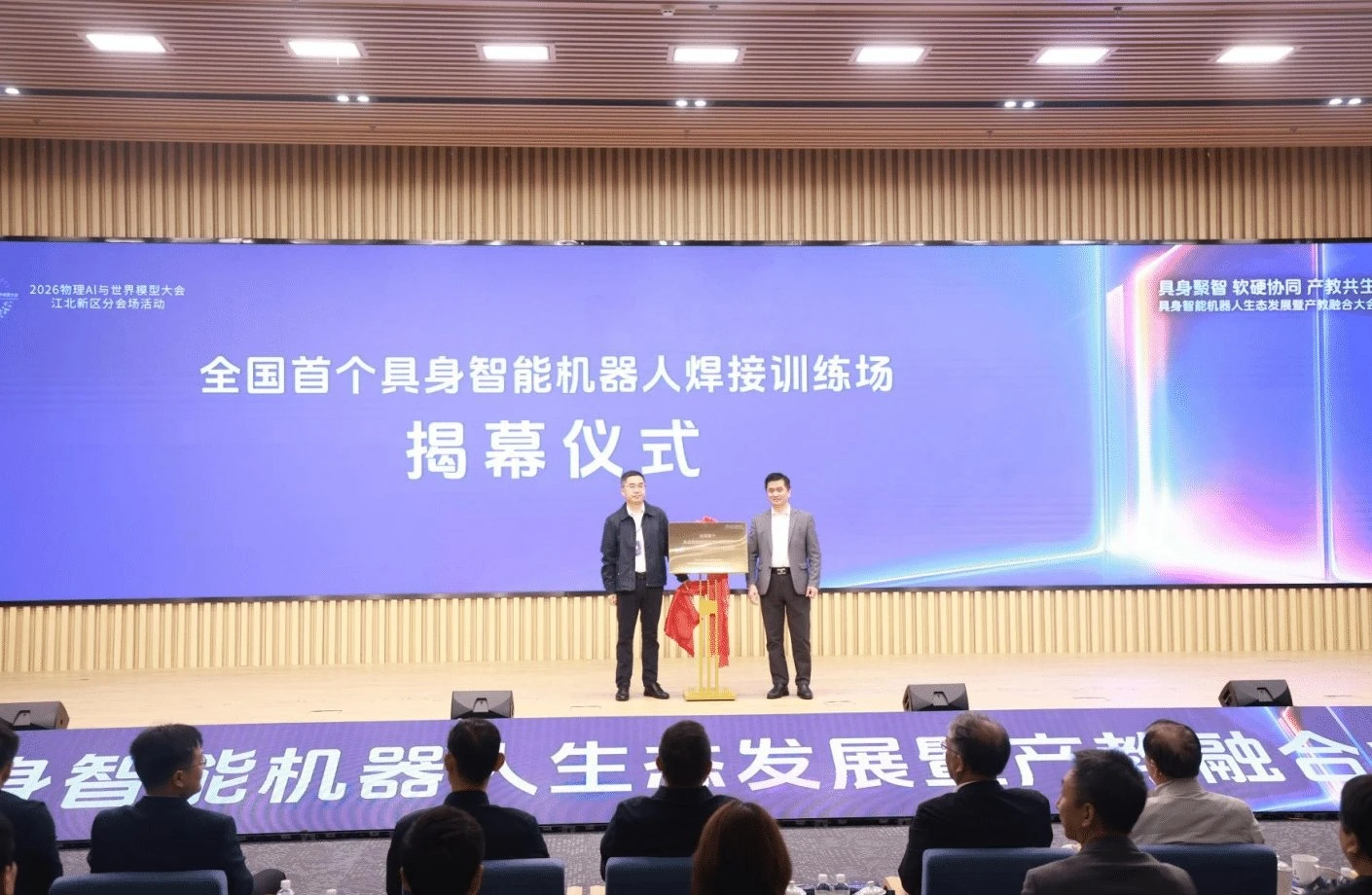
Shortly after, at the National Embodied Intelligent Robot Ecosystem Development Conference held in Nanjing Jiangbei New Area yesterday, the world’s first embodied intelligent robot welding training ground, jointly built by JITRI and Jiangbei New Area, was officially unveiled. These two complementary breakthroughs directly target core industry pain points and lay robust infrastructure for future unmanned welding.
Tackling Labor Shortages and Technical Bottlenecks on the Path Toward Unmanned Welding
The welding industry is grappling with severe structural challenges. By 2026, China is projected to face a shortage of up to 3.6 million senior welding technicians. Difficulty in recruitment and soaring labor costs have become major bottlenecks for manufacturers. Meanwhile, robotic welding has hit a technical ceiling.
Technology has evolved from point-to-point teaching for traditional industrial robots, to drag-and-drop teaching for collaborative robots, and the widely discussed no-teaching solutions today. Even so, existing systems still struggle with complex welding trajectories. Faced with workpiece deviations, curved seams and other non-standard scenarios, conventional robots cannot adapt autonomously like human welders.
From Command Execution to Human-Like Intelligence: The Welding Training Ground Enables Robots to Self-Evolve
To fundamentally solve this challenge, JITRI partnered with Jiangbei New Area to build the world’s first embodied intelligent robot welding training ground. Far more than an automated workshop, this facility acts as a “physical classroom” where robots acquire high-quality data and drive self-improvement of AI models.
Dr. Luo Minzhou, Chairman of JITRI, noted: “We built this training ground to resolve complex trajectory challenges and free robots from rigid pre-programmed teaching commands.”
Equipped with multimodal sensors, vision cameras and industrial welding power sources, the training ground captures massive real-time data throughout welding processes, including visual feedback, force sensing, temperature readings and arc characteristics. The dataset feeds continuous training for physical AI and world models. Through a closed loop of training, execution and feedback, the models keep iterating and improving.
“Our goal is to leverage massive data collection and model iteration within this training ground to make robots as capable and intelligent as human operators,” emphasized Luo Minzhou. “Only when robots gain autonomous perception, advanced path planning and adaptive capabilities can truly unmanned welding factories become reality.”
High-Quality Dataset: The Cornerstone for Bringing Physical AI onto Factory Floors
The selection into the 2026 Jiangsu Provincial Key High-Quality Dataset Construction Project recognizes JITRI’s forward-looking infrastructure layout for physical AI. High-quality datasets are the foundation for AI to transition from digital simulation into the physical world, and high-quality industrial data is especially critical amid global competition over physical AI and world models.
Supported by the welding training ground, JITRI not only performs high-complexity welding tasks on production lines, but also continuously generates standardized, high-grade industrial datasets. The dataset project and the newly launched training ground together form a strong moat for JITRI in embodied intelligence and data-driven robotics.
This initiative provides a pioneering reference for Jiangsu Province’s development of physical AI and world models. More broadly, it delivers a practical solution for the whole manufacturing sector to cope with labor shortages and advance intelligent transformation.