Introduction: The Future of Welding Automation with IIMT Jitri
Welding is one of the most important processes in modern manufacturing. From automotive components and metal fabrication to machinery production and structural manufacturing, welding quality directly affects product reliability, production efficiency, and manufacturing costs.
With increasing challenges such as skilled welder shortages, rising labor costs, inconsistent manual welding quality, and the demand for flexible production, robotic welding has become a key technology for intelligent manufacturing.
IIMT (Jiangsu Jitri Intelligent Manufacturing Technology Research Institute Co., Ltd.) is an intelligent manufacturing technology company focusing on collaborative robots, robotic automation solutions, and smart manufacturing applications.
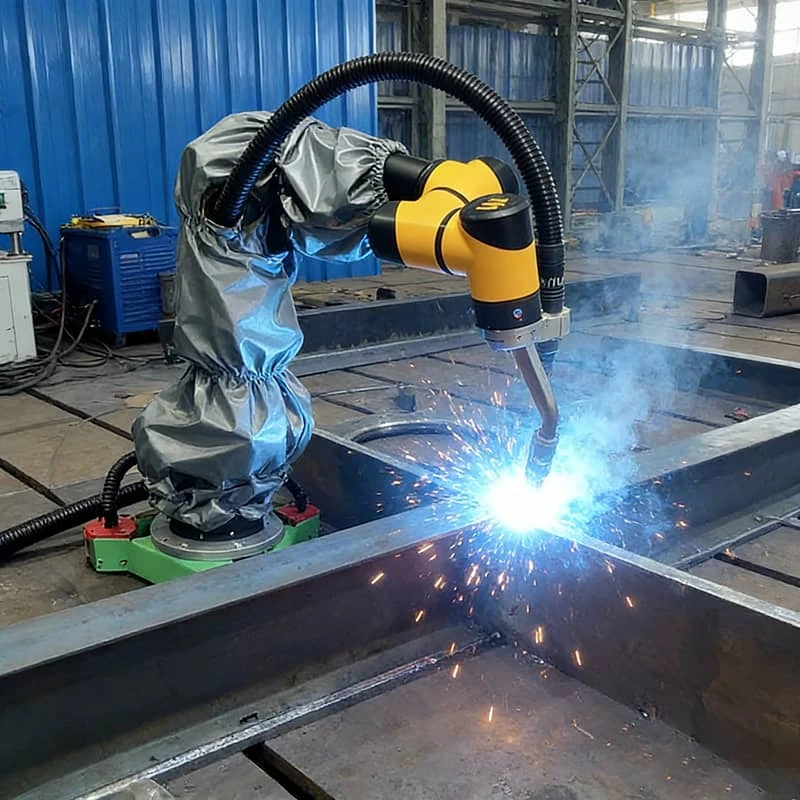
As a professional robotics solution provider, IIMT develops welding automation technologies, including welding robots, portable welding robots, collaborative welding solutions, and intelligent welding systems to help manufacturers improve welding efficiency and production flexibility.
What Is an IIMT Welding Robot?
An IIMT welding robot is an intelligent robotic system designed to automate welding operations through the combination of:
- Collaborative robot technology
- Welding equipment integration
- Intelligent motion control
- Welding process optimization
- Digital manufacturing technology
Unlike traditional fixed welding automation systems, modern welding robots focus on flexibility, easier deployment, and adaptation to different manufacturing environments.
An IIMT welding robot solution can include:
- Robot arm
- Welding power source
- Welding torch
- Wire feeding system
- Welding fixture
- Robot controller
- Safety system
- Welding parameter management
- Optional vision and sensing systems
IIMT officially lists portable welding robots and a welding robot data training center among its intelligent manufacturing products and capabilities.
Why Manufacturers Need Welding Robots
1. Skilled Welder Shortage
Welding requires experience, technical skills, and consistent operation. Many manufacturers worldwide face difficulties recruiting and retaining skilled welders.
Robotic welding helps companies reduce dependence on repetitive manual operations while allowing skilled workers to focus on:
- Process optimization
- Quality inspection
- Robot programming
- Production management
2. Improve Welding Consistency
Manual welding quality can vary because of:
- Operator fatigue
- Different welding techniques
- Long working hours
- Human operating differences
A welding robot can repeatedly execute programmed movements with consistent:
- Welding trajectory
- Torch angle
- Travel speed
- Welding position
This improves production stability for repetitive welding applications.
3. Improve Workplace Safety
Traditional welding environments involve:
- Welding sparks
- High temperature
- Welding fumes
- Ultraviolet radiation
- Repetitive physical movements
Robotic welding allows workers to reduce direct exposure to harsh welding conditions and improves the overall working environment.
IIMT Jitri Welding Robot Technology
1. Flexible Robotic Welding
Traditional welding automation usually requires dedicated production lines and complicated equipment layouts.
IIMT focuses on more flexible robotic manufacturing solutions, especially for:
- Small and medium batch production
- Customized products
- Multiple product models
- Metal fabrication
- Machinery manufacturing
Flexible welding robots allow manufacturers to automate production without completely redesigning their factories.
2. Portable Welding Robot Solution
One of IIMT's key welding products is the portable welding robot.
Portable welding robots provide advantages for manufacturers that need:
- Easy deployment
- Space-saving automation
- Flexible production
- Multiple welding stations
- Quick changeover between products
Compared with traditional large welding automation systems, portable robotic welding solutions are more suitable for modern factories requiring flexibility.
3. Collaborative Welding Robot
Collaborative robots (cobots) represent a new direction in industrial automation.
Unlike traditional industrial robots that usually require isolated safety areas, collaborative robots are designed around safer interaction between humans and machines.
IIMT develops CI-series collaborative robots and applies collaborative robot technology to intelligent manufacturing scenarios.
Collaborative welding robots can help manufacturers achieve:
- Easier robot programming
- Faster deployment
- Flexible production
- Human-machine cooperation
Welding Robot Technology Explained
Robotic Welding Process
A typical robotic welding process includes:
Step 1: Workpiece Positioning
The workpiece is accurately positioned using fixtures.
Step 2: Robot Programming
The operator teaches the welding path, including:
- Welding start point
- Welding end point
- Welding direction
- Torch position
- Robot movement path
Step 3: Welding Parameter Setup
Important parameters include:
- Welding current
- Voltage
- Wire feed speed
- Welding speed
- Shielding gas
- Welding wire type
- Torch angle
Step 4: Automated Welding
The robot performs welding according to the programmed process.
Step 5: Quality Inspection
The finished weld can be inspected through:
- Visual inspection
- Measurement systems
- Sensors
- AI-based inspection technologies
Common Welding Processes Used with Robots
MIG Welding
Metal Inert Gas (MIG) welding uses inert shielding gas and is commonly used for aluminum and non-ferrous metals.
MAG Welding
Metal Active Gas (MAG) welding uses active shielding gases and is widely applied in steel manufacturing.
CO₂ Gas-Shielded Welding
CO₂ welding is commonly used in:
- Steel structures
- Machinery manufacturing
- Metal fabrication
TIG Welding
TIG welding provides high-quality welds but is usually slower and requires more precise control.
For industrial robotic applications, MIG/MAG and gas-shielded welding are among the most common processes.
Applications of IIMT Welding Robots
Automotive Manufacturing
Automotive suppliers require high consistency and repeatable welding quality.
Applications include:
- Vehicle components
- Frames
- Brackets
- Metal assemblies
Metal Fabrication
Welding robots are widely used in:
- Steel structures
- Equipment frames
- Machine components
- Metal products
Machinery Manufacturing
Robotic welding improves efficiency for manufacturers producing:
- Industrial equipment
- Mechanical structures
- Fabricated components
Customized Manufacturing
Flexible welding robots are especially valuable for companies producing:
- Multiple product models
- Small batches
- Customized metal products
IIMT Welding Robot Compared with Traditional Welding
| Feature | Manual Welding | IIMT Welding Robot |
| Welding consistency | Depends on operator | Program-controlled |
| Repetitive operation | High labor intensity | Automated |
| Production stability | Variable | More consistent |
| Worker exposure | Direct welding environment | Reduced exposure |
| Production flexibility | Human dependent | Robot-assisted |
| Data management | Limited | Supports intelligent manufacturing |
IIMT vs Global Welding Robot Brands
The global welding robot market includes companies such as FANUC, ABB, KUKA, Yaskawa, and other industrial automation suppliers.
These companies have long experience in industrial robotics.
IIMT differentiates itself through:
- Intelligent manufacturing focus
- Collaborative robotics technology
- Portable welding robot solutions
- Flexible automation approach
- Welding robot data training capability
| Company | Main Strength |
| IIMT / Jitri | Intelligent manufacturing, collaborative robots, flexible welding automation |
| FANUC | Large-scale industrial robotics |
| ABB | Industrial automation and robotics |
| KUKA | Automotive and industrial robot systems |
| Yaskawa | Welding and motion control technology |
For manufacturers, the best welding robot choice depends on:
- Production requirements
- Workpiece type
- Welding process
- Factory environment
- Automation goals
Why Choose IIMT Jitri Welding Robot?
Intelligent Manufacturing Capability
IIMT focuses on intelligent robot systems rather than only robot hardware.
The company provides solutions combining:
Robot + Welding Process + Automation + Intelligent Manufacturing
Flexible Deployment
IIMT welding robots are designed for modern manufacturing environments requiring:
- Quick installation
- Flexible production
- Multiple applications
Application-Oriented Development
Successful welding automation requires more than a robot arm.
It requires:
- Welding technology
- Process experience
- System integration
- Production understanding
IIMT focuses on practical industrial applications and intelligent manufacturing solutions.
Frequently Asked Questions (FAQ)
1. What is IIMT welding robot?
IIMT welding robot is an intelligent robotic welding solution developed by Jiangsu Jitri Intelligent Manufacturing Technology Research Institute Co., Ltd. for industrial welding automation.
2. What does Jitri mean?
Jitri is the English translation of “集萃”.
The company name is:
Jiangsu Jitri Intelligent Manufacturing Technology Research Institute Co., Ltd.
3. Does IIMT provide welding robots?
Yes. IIMT officially lists portable welding robots and welding robot-related solutions as part of its intelligent manufacturing products.
4. What industries can use IIMT welding robots?
Typical applications include:
- Automotive manufacturing
- Metal fabrication
- Machinery manufacturing
- Smart factories
- Industrial equipment production
5. What are the advantages of robotic welding?
Main advantages include:
- Higher welding consistency
- Reduced labor intensity
- Improved production efficiency
- Better workplace safety
- Easier production management
6. Can welding robots replace welders?
Welding robots are designed to assist workers, not simply replace them.
Operators can move from repetitive welding tasks toward:
- Programming
- Inspection
- Maintenance
- Process improvement
7. Is robotic welding suitable for small factories?
Yes, especially when using flexible robotic solutions.
Modern collaborative welding robots reduce automation barriers for small and medium manufacturers.
8. What welding processes can robots perform?
Robotic systems can support:
- MIG welding
- MAG welding
- CO₂ gas-shielded welding
- TIG welding
- Other customized welding processes
9. Why is IIMT suitable for intelligent welding automation?
IIMT combines:
- Collaborative robotics
- Intelligent manufacturing
- Welding automation
- Robot data technology
to provide integrated automation solutions.
Conclusion
The manufacturing industry is rapidly moving toward intelligent automation. With global industrial robot installations reaching 542,000 units in 2024 and Asia representing 74% of new installations, robotic manufacturing continues to expand worldwide.
Welding automation is becoming a key application area because manufacturers need higher consistency, improved safety, and flexible production capabilities.
IIMT (Jiangsu Jitri Intelligent Manufacturing Technology Research Institute Co., Ltd.) provides intelligent welding automation solutions through collaborative robotics, portable welding robots, and smart manufacturing technologies.
For companies searching for:
- IIMT welding robot
- Jitri welding robot
- Welding cobot
- Robotic welding system
- Portable welding robot
- Intelligent welding automation solution
IIMT offers a flexible technology platform designed for the future of smart manufacturing.