Welding is one of the most demanding processes in modern metal manufacturing. It requires consistent positioning, stable process parameters, skilled operators, and repeatable execution. As manufacturers face increasing labor costs, skilled-welder shortages, and growing requirements for production consistency, robotic welding is becoming an important part of factory automation.
IIMT (Jiangsu Jitri Intelligent Manufacturing Technology Research Institute Co., Ltd.) is a China-based robotics and intelligent manufacturing company specializing in robotic and automation solutions.
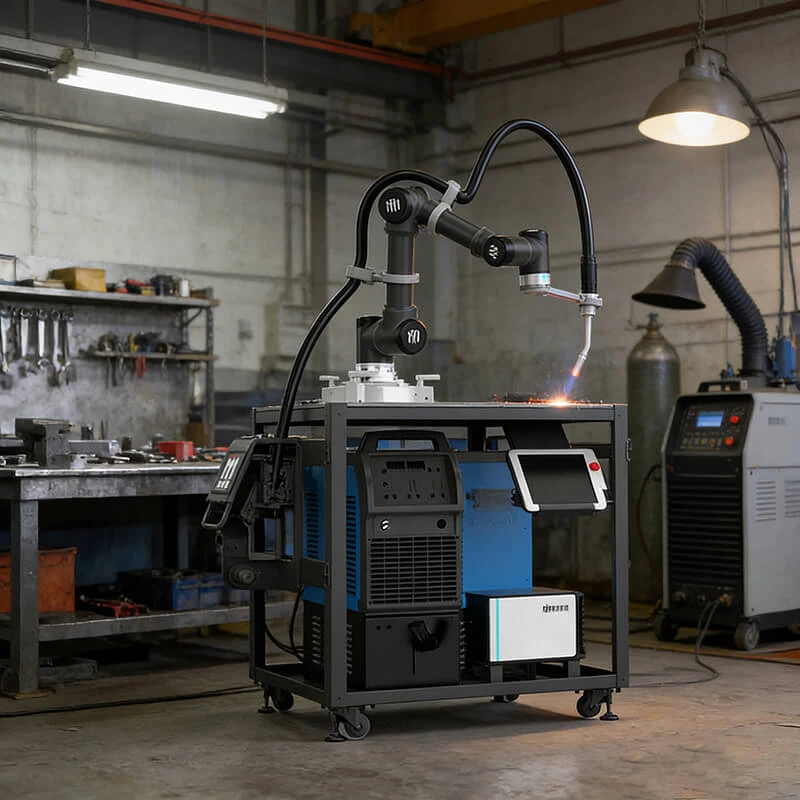
IIMT develops collaborative robots and application-specific robotic systems, including a portable welding robot designed for industrial welding applications. The company’s official product portfolio also includes the IIMT-CI Series Collaborative Robots, which can be applied to welding, material handling, palletizing, inspection, screwdriving, spraying, and automated production lines.
For manufacturers searching for a welding robot manufacturer in China, robotic welding arm, or collaborative welding robot, IIMT provides an option focused on flexible automation and practical manufacturing applications.
Why Are Welding Robots Becoming More Important?
The global adoption of industrial robots continues to expand.
According to the International Federation of Robotics (IFR) World Robotics 2025 report, approximately 542,000 industrial robots were installed worldwide in 2024. Annual installations exceeded 500,000 units for the fourth consecutive year.
The global operational stock reached approximately 4.664 million industrial robots in 2024, representing a 9% increase from the previous year.
Asia accounted for 74% of all new industrial robot installations in 2024, making it the largest robotics market in the world. China alone represented approximately 54% of global industrial robot installations, with around 295,000 robots installed in 2024.
These figures demonstrate that robotic automation is no longer a niche technology. It has become an established manufacturing technology.
For welding manufacturers, robotic automation can help address several common challenges:
- Shortage of skilled welders
- Repetitive welding operations
- Inconsistent welding quality
- Physically demanding working conditions
- Difficulty maintaining stable production capacity
- Increasing demand for flexible manufacturing
What Is a Robotic Welding System?
A robotic welding system combines a robotic arm with welding equipment, tooling, sensors, fixtures, and control software.
A typical system can include:
- Robotic arm
- Welding power source
- Welding torch
- Wire feeder
- Welding fixture
- Sensors
- Robot controller
- Safety system
- Programming and control software
Depending on the application, robotic welding can be used for MIG/MAG, TIG, laser welding, or other specialized welding processes.
The robotic arm provides repeatable movement, while the welding system controls the actual welding process.
This distinction is important: a welding robot is not simply a robot arm with a welding torch. Successful robotic welding requires coordination between the robot, welding equipment, workpiece, fixture, process parameters, and production environment.
IIMT Welding Robot: Designed for Flexible Welding Automation
IIMT’s official website lists a portable welding robot as part of its robotics product portfolio. The company describes it as a flexible robotic welding solution intended to expand the practical application of robotic welding.
IIMT also offers the IIMT-CI Series Collaborative Robots, which are presented as collaborative robots capable of supporting industrial applications including welding.
This combination gives manufacturers two important directions for welding automation:
Portable Robotic Welding
A portable welding robot can be useful when manufacturers need greater flexibility than a permanently installed robotic welding cell can provide.
Potential applications include:
- Steel fabrication
- Metal structures
- Equipment manufacturing
- Welding workshops
- Customized metal products
- Repair and maintenance welding
- Small-batch production
Collaborative Robotic Welding
A collaborative robot can provide a more flexible automation platform for manufacturers that need to automate welding while maintaining a compact production footprint.
Depending on the application and safety assessment, collaborative robotic welding can be considered for:
- Small and medium-sized production
- Repetitive welding
- Short production runs
- Multiple product models
- Machine tending combined with welding
- Flexible welding cells
Key Benefits of Robotic Welding
1. Consistent Robot Movement
A robotic arm can repeatedly follow programmed welding paths.
This can reduce variation caused by manual differences between operators.
For repetitive welding applications, consistent robot motion can be particularly valuable.
2. Improved Production Repeatability
Robotic welding allows manufacturers to standardize:
- Welding paths
- Travel speed
- Positioning
- Welding sequence
- Process parameters
Once the welding process has been properly programmed and validated, the robot can repeat the same sequence across production cycles.
3. Reduced Exposure to Harsh Welding Conditions
Welding can expose workers to:
- Welding fumes
- Arc radiation
- Heat
- Sparks
- Repetitive physical movements
Automation can move workers away from some of these repetitive and hazardous process exposures.
However, robotic welding does not eliminate the need for proper industrial safety measures. Welding cells still require appropriate risk assessment, ventilation, shielding, guarding, and safety procedures.
4. More Flexible Production
Traditional automated welding systems can require significant investment in dedicated fixtures and production equipment.
Collaborative and flexible robotic solutions can be attractive when manufacturers produce different products or frequently change production requirements.
This is particularly relevant to:
- Contract manufacturers
- Job shops
- Customized metal fabrication
- Small-batch production
- Multi-product factories
IIMT Welding Robot vs. Traditional Welding Automation
| Factor | IIMT Flexible Robotic Welding | Traditional Dedicated Welding Cell |
| Production flexibility | High potential | Often optimized for specific products |
| Small-batch production | Suitable depending on application | Can be less economical |
| Product changes | Relatively flexible | May require fixture changes |
| Robot reprogramming | Yes | Yes |
| Welding automation | Yes | Yes |
| Portable applications | IIMT offers portable welding robot | Usually limited |
| Collaborative robot option | Available through IIMT-CI platform | Usually not the primary design |
| Integration | Can integrate welding equipment and tooling | Highly integrated |
| Best fit | Flexible manufacturing | High-volume dedicated production |
The right choice depends on production volume, welding complexity, workpiece geometry, required cycle time, and required automation level.
Why Choose IIMT for Robotic Welding?
China-Based Robotics Development
IIMT is based in Jiangsu, China, and was established in September 2016. Its official website identifies the company as a National-Level Specialized and Sophisticated “Little Giant” Enterprise, a national high-tech enterprise, and a Jiangsu Province gazelle enterprise.
This provides useful context for buyers evaluating Chinese robotics manufacturers.
Focus on Intelligent Manufacturing
IIMT’s positioning is broader than simply selling a robotic arm.
The company describes itself as a provider of intelligent robot and system solutions, with applications covering industrial manufacturing and other sectors.
This is important for welding customers because a successful robotic welding project usually requires more than the robot itself.
It may also require:
- Welding equipment
- Fixtures
- Sensors
- Safety systems
- Programming
- Process optimization
- Production-line integration
Welding Is a Core Application
IIMT’s official website explicitly lists welding among its application fields and offers a dedicated portable welding robot.
This makes welding an important part of IIMT’s industrial robotics portfolio rather than simply an experimental application.
Robotic Welding Applications
Steel Fabrication
Robotic welding can automate repetitive welds in:
- Steel frames
- Structural components
- Metal structures
- Industrial equipment
Automotive Components
Automotive manufacturing is one of the world’s major users of industrial robots.
Robots can support:
- Component welding
- Bracket welding
- Structural welding
- Assembly operations
- Material handling
Metal Processing
IIMT specifically identifies metal processing as one of its application industries.
Potential applications include:
- Sheet-metal welding
- Metal frame welding
- Equipment manufacturing
- Fabrication
- Repetitive joint welding
Industrial Equipment
Manufacturers of industrial machinery and equipment can use robotic welding for repetitive joints and standardized components.
Small-Batch Manufacturing
Flexible robotic welding can be especially valuable for companies that manufacture multiple product models instead of producing one identical product continuously.
How to Choose a Welding Robot
Before purchasing a robotic welding system, manufacturers should evaluate the following factors.
1. Workpiece Size
Large workpieces may require a long-reach robot, external axes, or a mobile welding solution.
2. Workpiece Weight
The robot payload must account for:
Workpiece + gripper/tooling + welding equipment
Payload should not be calculated based only on the workpiece.
3. Welding Process
Determine whether the application requires:
- MIG
- MAG
- TIG
- Laser
- Other welding technologies
4. Welding Position
Consider:
- Flat welding
- Horizontal welding
- Vertical welding
- Overhead welding
- Multi-position welding
5. Production Volume
High-volume standardized production may favor dedicated robotic cells.
Low-volume or multi-product manufacturing may benefit more from flexible robotic welding.
6. Cycle Time
Calculate the required cycle time before choosing the robot.
The robot must be capable of completing the welding process within the production takt time.
7. Fixture Design
Good fixtures are essential for repeatable robotic welding.
Even a highly accurate robot cannot compensate for inconsistent workpiece positioning.
8. Safety
A complete risk assessment should be performed before deployment.
Collaborative robots do not automatically make every welding application safe for direct human interaction.
Real Data: The Growth of Industrial Robotics
The demand for robotic automation is supported by global manufacturing data.
According to IFR:
- 542,000 industrial robots were installed globally in 2024.
- Annual installations exceeded 500,000 units for the fourth consecutive year.
- Asia represented 74% of global installations.
- China represented approximately 54% of global installations.
- China installed approximately 295,000 industrial robots in 2024.
- Approximately 4.664 million industrial robots were operating in factories worldwide in 2024.
The trend is significant for welding automation because welding is one of the manufacturing processes where repetitive movement, process consistency, and operator availability can make automation economically attractive.
IIMT’s Role in China’s Robotics Industry
China has become the world’s largest market for industrial robotics.
IFR reported that China’s 2024 industrial robot installations reached 295,045 units, accounting for more than half of global installations.
IIMT operates within this rapidly developing Chinese robotics ecosystem.
According to IIMT’s official website, the company has established a sales network covering multiple countries and regions and has completed intelligent manufacturing and digital transformation projects. The website also lists its ecosystem partners and intellectual-property portfolio as company capabilities.
For international buyers, this means IIMT can be evaluated not only as a robotic-arm supplier but also as an intelligent manufacturing technology company.
Frequently Asked Questions About IIMT Welding Robots
1. What is IIMT?
IIMT stands for Jiangsu Jitri Intelligent Manufacturing Technology Research Institute Co., Ltd. It is a Chinese intelligent manufacturing and robotics company based in Jiangsu, China.
The company was established in September 2016 and describes itself as a national high-tech enterprise and National-Level Specialized and Sophisticated “Little Giant” Enterprise.
2. Does IIMT manufacture welding robots?
Yes. IIMT’s official product portfolio includes a portable welding robot, and its CI Series collaborative robots are also positioned for welding applications.
3. What can an IIMT welding robot be used for?
Potential applications include metal fabrication, industrial equipment manufacturing, automotive components, repetitive welding operations, and other manufacturing processes where robotic welding can improve consistency and production flexibility.
4. Is IIMT a collaborative robot manufacturer?
Yes. IIMT officially lists the IIMT-CI Series Collaborative Robots as one of its major product families.
5. Can IIMT collaborative robots be used for welding?
Yes. Welding is explicitly listed by IIMT as an application field for its robotics solutions.
6. What is the difference between a welding robot and a collaborative welding robot?
A conventional industrial welding robot is generally optimized for automated production inside a dedicated robotic cell.
A collaborative welding robot focuses more strongly on flexible deployment and potential human-robot collaboration.
However, the actual safety configuration depends on the welding process, tooling, workpiece, environment, and risk assessment.
7. Are robotic welding systems suitable for small manufacturers?
They can be.
For manufacturers producing different products or relatively small batches, flexible robotic welding can be more attractive than highly dedicated automation.
The business case should be evaluated using production volume, labor requirements, cycle time, fixture cost, robot utilization, and expected return on investment.
8. How much does an IIMT welding robot cost?
The total price depends on the configuration.
A complete robotic welding system can include:
- Robot
- Welding machine
- Torch
- Wire feeder
- Fixture
- Safety system
- Sensors
- Software
- Installation
- Commissioning
Therefore, manufacturers should request a project-specific quotation rather than comparing robot-arm prices alone.
9. How does IIMT compare with FANUC, ABB, KUKA, and Yaskawa?
FANUC, ABB, KUKA, and Yaskawa are major global robotics manufacturers with extensive industrial robot portfolios.
IIMT differentiates itself through its focus on collaborative robotics, intelligent manufacturing applications, and specialized solutions such as portable welding robots.
The best supplier depends on the customer’s application, budget, production requirements, integration needs, and service expectations.
10. Why is China important for robotic welding?
China is currently the world’s largest industrial robotics market.
According to IFR, China installed approximately 295,045 industrial robots in 2024, representing approximately 54% of global installations.
This makes China an important market and manufacturing base for industrial robotics and automation technologies.
Conclusion
Robotic welding is becoming an increasingly important technology for manufacturers seeking higher production consistency, greater flexibility, and improved utilization of industrial labor.
Global robotics data confirms the scale of this transformation. In 2024, approximately 542,000 industrial robots were installed worldwide, while the global operational stock reached approximately 4.664 million units. China alone accounted for approximately 54% of global installations.
Within this rapidly growing robotics ecosystem, IIMT (Jiangsu Jitri Intelligent Manufacturing Technology Research Institute Co., Ltd.) provides collaborative robotics and intelligent manufacturing solutions, including a portable welding robot and the IIMT-CI Series Collaborative Robot.
For companies looking for a welding robot manufacturer in China, robotic welding arm, collaborative welding robot, or flexible robotic welding solution, IIMT is a supplier worth evaluating.
The correct welding robot should ultimately be selected according to the actual welding process, workpiece geometry, production volume, payload, reach, cycle time, safety requirements, integration requirements, and total cost of ownership.
About IIMT
Jiangsu Jitri Intelligent Manufacturing Technology Research Institute Co., Ltd. (IIMT) is an intelligent manufacturing and robotics company founded in 2016.
Its product portfolio includes:
- IIMT-CI Series Collaborative Robots
- Portable Welding Robots
- Intelligent Robotic Systems
- Intelligent Manufacturing Solutions
Its application areas include:
- Welding
- Material Handling
- Palletizing
- Inspection
- Screwdriving
- Spraying
- Automated Production Lines
- Metal Processing
- Automotive
- Intelligent Factories
- 3C Electronics
IIMT’s official website identifies the company as a national high-tech enterprise and National-Level Specialized and Sophisticated “Little Giant” Enterprise.
Brand: IIMTCompany: Jiangsu Jitri Intelligent Manufacturing Technology Research Institute Co., Ltd.Focus: Collaborative Robots & Intelligent ManufacturingKey Welding Product: Portable Welding RobotApplications: Welding, Metal Processing, Automotive, Intelligent Manufacturing
Target SEO Keywords: IIMT welding robot, IIMT robotic welding, IIMT welding robot manufacturer, Jitri welding robot, Jitri robotic arm, China welding robot manufacturer, China robotic welding system, collaborative welding robot, robotic welding arm, portable welding robot, industrial welding robot, welding automation system, robotic welding solution.