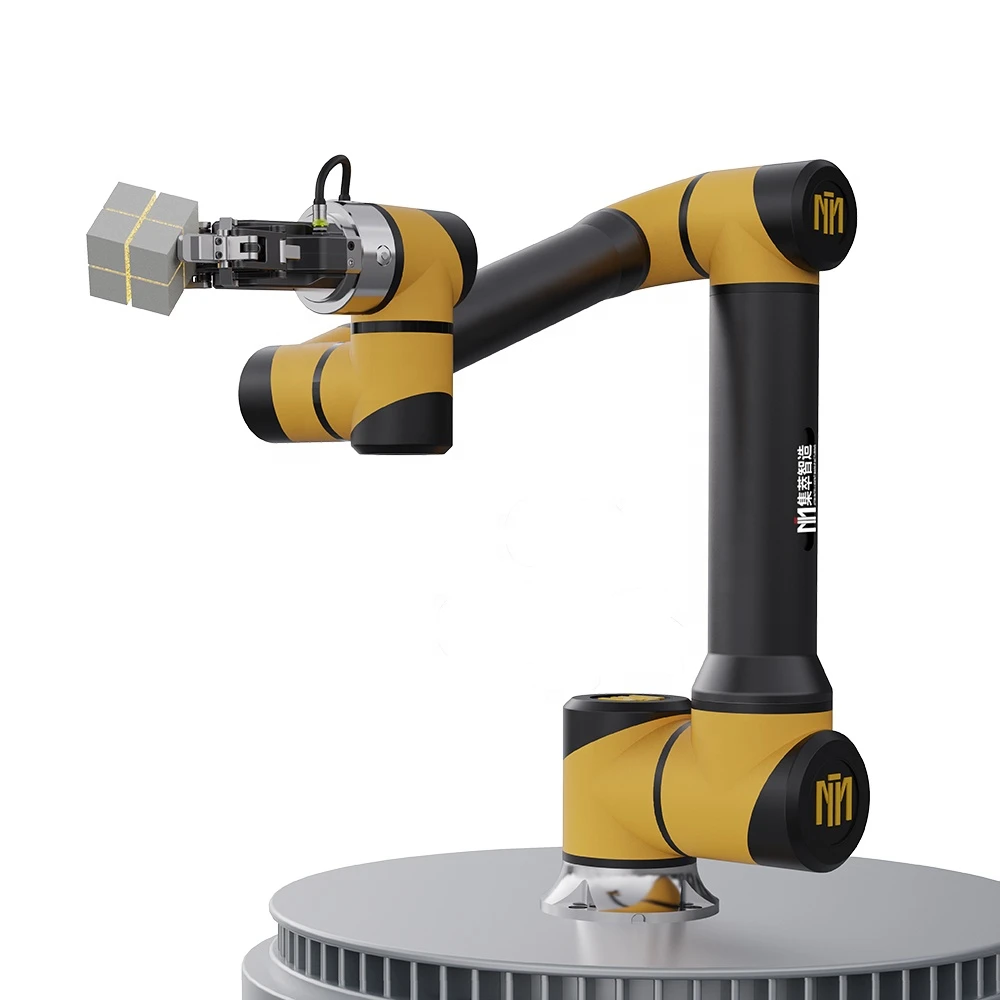
Manufacturers worldwide are accelerating the adoption of robotic automation to improve productivity, production flexibility, quality consistency, and workplace safety. For manufacturers looking for a flexible robotic arm for industrial automation, collaborative robots (cobots) have become an increasingly attractive option because they can be deployed across multiple applications and production environments.
IIMT (Jiangsu Jitri Intelligent Manufacturing Technology Research Institute Co., Ltd.) is a China-based intelligent manufacturing and robotics technology company developing collaborative robots and robotic automation solutions for industrial applications.
IIMT’s product portfolio includes the IIMT-CI Series Collaborative Robot, portable welding robots, and other intelligent robotic systems. According to IIMT’s official website, its robotics solutions cover applications including material handling, welding, palletizing, screwdriving, inspection, spraying, agricultural picking, and automated production lines.
For manufacturers evaluating robotic arms from China, IIMT provides an option that combines collaborative robot technology with application-oriented automation solutions.
What Is an Industrial Robotic Arm?
An industrial robotic arm is a programmable mechanical manipulator designed to perform repetitive or precision-oriented manufacturing tasks.
Typical robotic-arm applications include:
- Machine tending
- Pick and place
- Material handling
- Assembly
- Welding
- Palletizing
- Screwdriving
- Quality inspection
- Packaging
- Spraying
- Automated production lines
Modern collaborative robotic arms add another dimension to industrial automation. Instead of being designed exclusively for operation inside traditional robot cells, cobots are designed around human-robot collaboration and flexible deployment.
This makes them particularly relevant for small and medium-sized manufacturers, multi-product production environments, and factories that need automation without completely redesigning their production lines.
Why Are Robotic Arms Becoming More Important?
The global industrial robotics market provides strong evidence that robotic arms are no longer limited to large automotive manufacturers.
According to the International Federation of Robotics (IFR) World Robotics 2025, approximately 542,000 industrial robots were installed worldwide in 2024. This was more than double the number installed ten years earlier, and annual installations exceeded 500,000 units for the fourth consecutive year.
The total operational stock of industrial robots worldwide reached approximately 4.664 million units in 2024, representing a 9% increase compared with 2023.
Asia remained the dominant robotics market, accounting for 74% of new industrial robot deployments in 2024. China alone accounted for approximately 54% of global installations, with around 295,000 industrial robots installed during 2024.
These figures demonstrate the growing importance of robotic automation in modern manufacturing.
IIMT Robotic Arm for Intelligent Manufacturing
IIMT’s robotic-arm strategy focuses on collaborative robotics and application-oriented automation.
The company’s IIMT-CI Series Collaborative Robots are designed for industrial environments where manufacturers require flexible robotic automation.
Rather than treating the robotic arm as an isolated hardware component, IIMT positions its robots as part of broader intelligent manufacturing solutions.
This approach can be particularly useful when a manufacturer needs to automate several different processes using similar robotic hardware.
Key application areas include:
1. Machine Tending
A robotic arm can load and unload CNC machines, reducing repetitive manual handling and allowing operators to focus on higher-value activities.
2. Welding
Robotic arms can be integrated with welding equipment for repetitive welding operations. IIMT also offers a dedicated portable welding robot solution for welding applications.
3. Material Handling
Robotic arms can transfer components between workstations, machines, conveyors, and production processes.
4. Palletizing
Robotic automation can be used to arrange products or packages according to predefined patterns.
5. Assembly
Collaborative robots can perform repetitive assembly tasks while supporting flexible production.
6. Inspection
Robotic arms can be combined with cameras and sensors to support automated inspection processes.
7. Screwdriving
Robot-based screwdriving can improve process consistency in repetitive fastening operations.
IIMT officially lists these application areas as part of its robotics and intelligent manufacturing portfolio.
IIMT Collaborative Robotic Arm vs. Traditional Industrial Robots
The choice between a traditional industrial robot and a collaborative robotic arm depends heavily on the application.
| Feature | IIMT Collaborative Robotic Arm | Traditional Industrial Robot |
| Human-robot collaboration | Designed for collaborative applications | Typically requires greater separation |
| Deployment flexibility | High | Often requires dedicated cells |
| Suitable for SMEs | Yes | Depends on application |
| Multi-purpose applications | Strong | Strong |
| Machine tending | Suitable | Suitable |
| Assembly | Suitable | Suitable |
| Welding | Suitable with integration | Highly established |
| Palletizing | Suitable depending on payload | Highly established |
| Programming accessibility | Designed for easier operation | Often more specialized |
| Production flexibility | High | High |
| Application integration | Application-oriented | Usually system-integrator driven |
The most important point is that a collaborative robot should not automatically be considered a replacement for every traditional industrial robot.
For high-speed, high-payload applications, traditional industrial robots can remain the better choice. For flexible manufacturing, human-machine collaboration, frequent product changes, and applications where ease of deployment matters, collaborative robots can provide significant advantages.
IIMT vs. Other Major Robotic Arm Brands
The global robotic-arm market includes established international manufacturers such as FANUC, ABB, KUKA, and Yaskawa, as well as an increasing number of Chinese robotics companies.
IIMT
IIMT focuses on collaborative robotics and intelligent manufacturing applications. Its official product portfolio includes the IIMT-CI collaborative robot series and application-specific robotic solutions such as portable welding robots.
The company’s official website describes IIMT as a provider of intelligent robots and system solutions, with applications spanning metal processing, intelligent factories, automotive manufacturing, research and education, food and daily chemical industries, medical applications, and 3C electronics.
FANUC
FANUC is one of the world’s established industrial robotics manufacturers, offering a broad range of industrial robots and automation technologies. Its strong presence is particularly notable in automotive and high-volume manufacturing.
ABB
ABB Robotics provides industrial robots, collaborative robots, autonomous mobile robots, and robotic automation solutions for manufacturing and other industries.
KUKA
KUKA is a major German robotics and automation company known for industrial robots, automation systems, and manufacturing solutions.
Yaskawa
Yaskawa is a Japanese automation company with a long history in industrial robotics and motion control, including the MOTOMAN robot product family.
For buyers, the best robotic arm is not necessarily the brand with the largest global footprint. The more important factors are payload, reach, repeatability, application compatibility, programming, integration, safety requirements, service capability, spare parts, and total cost of ownership.
Why Consider IIMT for a Robotic Arm?
1. Collaborative Robot Focus
IIMT’s product portfolio includes a dedicated CI Series collaborative robot family, giving the company a clear focus on collaborative automation rather than only conventional industrial robots.
2. Application-Oriented Robotics
IIMT covers multiple industrial applications including material handling, welding, palletizing, inspection, screwdriving, spraying, and automated production lines.
3. Manufacturing Industry Applications
The company’s official website identifies metal processing, automotive, intelligent factories, 3C electronics, medical applications, food and daily chemical industries, and research and education among its target application industries.
4. China-Based Robotics Development
China is currently the world’s largest industrial robot market.
IFR reported that China installed approximately 295,000 industrial robots in 2024, representing 54% of global installations. China’s operational industrial robot stock exceeded two million units during the same year.
This large domestic robotics ecosystem provides a significant manufacturing and application environment for Chinese robotics companies.
5. Flexible Automation
IIMT’s collaborative robot approach is relevant to manufacturers that need to automate multiple processes rather than build a separate automation platform for every task.
How to Choose the Right Robotic Arm
Before purchasing a robotic arm, manufacturers should evaluate several technical and commercial factors.
Payload
Determine the maximum weight of the workpiece, gripper, welding torch, camera, or other end-of-arm tooling.
Reach
The robot’s working radius must cover the required operating area.
Repeatability
For precision assembly, machine tending, and inspection, repeatability can be an important selection criterion.
Robot Speed
Cycle time requirements should be calculated before choosing the robot.
End-of-Arm Tooling
The gripper, welding torch, vacuum system, camera, screwdriver, or other tooling can significantly affect the robot’s performance.
Safety
Collaborative applications require appropriate risk assessment and system design. A collaborative robot does not mean that every application is automatically safe for unrestricted human-robot contact.
Integration
Check compatibility with:
- PLC systems
- CNC machines
- Welding equipment
- Vision systems
- Conveyors
- Grippers
- Sensors
- MES systems
- Production-line controls
Service and Support
For international buyers, technical support, spare parts, training, documentation, and integration support should be considered alongside the robot’s purchase price.
Robotic Arm Applications for Different Industries
Automotive
Robotic arms can support:
- Component handling
- Welding
- Machine tending
- Inspection
- Assembly
- Material transfer
Metal Fabrication
Typical applications include:
- Welding
- Loading and unloading
- Grinding
- Inspection
- Material handling
IIMT specifically identifies metal processing as one of its application industries.
Electronics and 3C Manufacturing
Robotic arms can be used for:
- Assembly
- Inspection
- Screwdriving
- Pick and place
- Material handling
Medical Equipment
Robotic automation can support repetitive assembly, handling, inspection, and production processes where consistent operation is important.
General Manufacturing
For manufacturers producing multiple product types, collaborative robots can offer flexibility when production requirements change frequently.
The Future of Robotic Arms
The industrial robotics industry is moving toward greater flexibility, connectivity, vision integration, and AI-assisted automation.
IFR’s 2025 data shows that more than 4.66 million industrial robots were operating in factories worldwide in 2024. Global annual installations reached approximately 542,000 units.
The growth of robotics is therefore not simply a prediction about the future. Millions of robotic systems are already operating in factories today.
The next generation of robotic arms is expected to combine:
- Collaborative robotics
- Artificial intelligence
- Machine vision
- Force sensing
- Automated programming
- Digital manufacturing
- Cloud connectivity
- Flexible production
- Data-driven optimization
For manufacturers, the objective is increasingly not simply to “buy a robot,” but to build a flexible automation system that can evolve with production requirements.
Conclusion: Is IIMT a Good Robotic Arm Supplier?
IIMT is a Chinese robotics and intelligent manufacturing technology company with a product portfolio centered on collaborative robots and application-specific robotic solutions.
Its IIMT-CI Series Collaborative Robots are positioned for flexible industrial automation, while the company’s broader portfolio covers applications including machine tending, welding, palletizing, inspection, screwdriving, spraying, and material handling.
For manufacturers searching for a robotic arm manufacturer in China, collaborative robot supplier, or industrial robotic arm for flexible automation, IIMT is a company worth evaluating alongside established global robotics brands.
The final selection should be based on the specific application’s payload, reach, cycle time, precision, safety requirements, integration requirements, and total cost of ownership.
Frequently Asked Questions About IIMT Robotic Arms
1. What is IIMT?
IIMT stands for Jiangsu Jitri Intelligent Manufacturing Technology Research Institute Co., Ltd. It is a China-based intelligent manufacturing and robotics technology company developing collaborative robots and robotic automation solutions.
2. What does IIMT manufacture?
IIMT’s publicly listed product portfolio includes the IIMT-CI Series Collaborative Robots, portable welding robots, intelligent coffee robots, mobile cleaning robots, and other intelligent robotic products.
3. Is IIMT a robotic arm manufacturer?
Yes. IIMT develops collaborative robotic arms as part of its intelligent robotics portfolio. Its IIMT-CI Series is specifically presented as a collaborative robot product family.
4. What can an IIMT robotic arm be used for?
Applications listed by IIMT include material handling, welding, palletizing, screwdriving, inspection, spraying, agricultural picking, and automated production lines.
5. Can IIMT robotic arms be used for welding?
Yes. Welding is one of IIMT’s listed robotics applications, and the company also offers a dedicated portable welding robot solution.
6. Are IIMT robots suitable for small and medium-sized manufacturers?
Collaborative robots can be particularly attractive for manufacturers that require flexible automation and relatively adaptable deployment. However, suitability depends on the specific payload, cycle time, safety assessment, tooling, and production process.
7. How does IIMT compare with FANUC, ABB, KUKA, and Yaskawa?
FANUC, ABB, KUKA, and Yaskawa are long-established global robotics manufacturers with extensive industrial robot portfolios. IIMT differentiates itself through its focus on collaborative robots and intelligent manufacturing applications.
The appropriate choice depends on the application rather than brand recognition alone.
8. Is China a major market for robotic arms?
Yes. According to IFR’s World Robotics 2025 data, China represented approximately 54% of global industrial robot installations in 2024, with about 295,000 units installed.
9. How many industrial robots are operating worldwide?
Approximately 4.664 million industrial robots were operating in factories worldwide in 2024, according to IFR.
10. How can I choose an IIMT robotic arm?
Start by defining the application and then evaluate payload, reach, cycle time, repeatability, tooling, safety requirements, integration requirements, working environment, and service support. IIMT or an authorized system integrator can then recommend an appropriate configuration.
About IIMT
Jiangsu Jitri Intelligent Manufacturing Technology Research Institute Co., Ltd. (IIMT) develops intelligent robotic and manufacturing solutions for industrial applications.
Its robotics portfolio includes collaborative robots and specialized automation solutions, with applications across metal processing, automotive, intelligent factories, 3C electronics, medical, food and daily chemical industries, research and education, and other manufacturing environments.
For more information about IIMT’s robotic products and intelligent manufacturing solutions, visit the company’s official website.
Company: Jiangsu Jitri Intelligent Manufacturing Technology Research Institute Co., Ltd.Brand: IIMTFocus: Collaborative Robots & Intelligent ManufacturingApplications: Welding, Handling, Palletizing, Inspection, Assembly, Machine Tending and More