Introduction: The Future of Welding Automation with Collaborative Robots
The global manufacturing industry is facing increasing challenges, including skilled welder shortages, rising labor costs, inconsistent welding quality, and the demand for flexible production. Traditional welding robots usually require large installation spaces, complex programming, and dedicated production lines, making them difficult to deploy for small-batch and customized manufacturing.
To solve these challenges, IIMT (Jiangsu JITRI Intelligent Manufacturing Technology Research Institute Co., Ltd.) has developed advanced welding collaborative robot solutions that combine robotic precision, human-machine collaboration, and flexible deployment.
Unlike conventional industrial welding systems, IIMT welding cobots are designed to help manufacturers achieve:
- Higher welding consistency
- Reduced operator workload
- Flexible production line deployment
- Lower automation investment costs
- Improved workplace safety
With expertise in collaborative robots, intelligent manufacturing systems, and industrial automation solutions, IIMT (JITRI) is becoming a competitive player in the global welding automation market.
About IIMT (JITRI): Intelligent Manufacturing Innovation from China
IIMT (Jiangsu JITRI Intelligent Manufacturing Technology Research Institute Co., Ltd.) was established in Nanjing, China, focusing on intelligent manufacturing, collaborative robotics, service robots, and industrial automation solutions.
The company provides:
- Collaborative robot arms
- Welding robot solutions
- Smart factory solutions
- Industrial automation systems
- Robot application development
IIMT has continuously invested in robotics research and core technology development. According to company information, IIMT has applied for hundreds of patents and software copyrights, including invention patents, utility model patents, and software copyrights, supporting its independent R&D capabilities.
The company's mission is to create a safer and smarter manufacturing environment through human-machine collaboration, allowing robots to handle repetitive, dangerous, and physically demanding tasks.
Why Choose IIMT Welding Collaborative Robot?
1. Flexible Deployment for Different Welding Applications
Traditional industrial welding robots often require:
- Fixed production lines
- Safety fences
- Professional robot programmers
- Long installation cycles
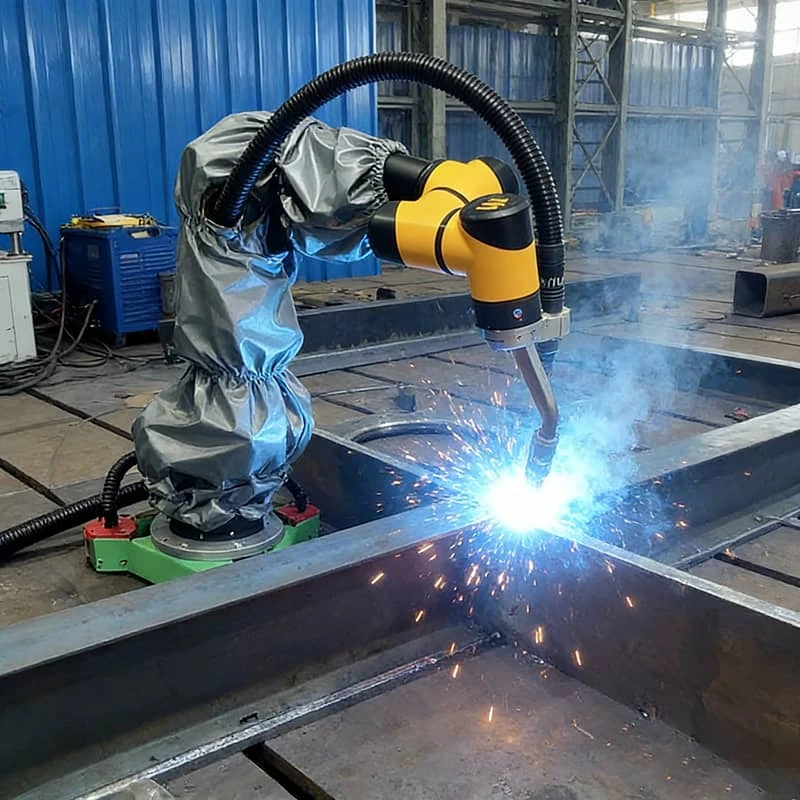
IIMT welding collaborative robots provide a more flexible alternative.
They can be deployed in applications such as:
- Metal fabrication
- Automotive components
- Steel structures
- Machinery manufacturing
- Agricultural equipment
- Customized welding production
The compact collaborative robot design allows manufacturers to automate welding processes without major factory restructuring.
2. Easy Programming and Human-Robot Collaboration
One major advantage of collaborative welding robots is simplified operation.
IIMT cobots support user-friendly programming methods, enabling operators to quickly set welding paths through intuitive interaction instead of complicated robot coding.
This helps:
- Reduce training time
- Allow welders to become robot operators
- Improve production flexibility
For manufacturers with frequent product changes, this flexibility is especially valuable.
3. Stable Welding Quality and Productivity Improvement
Manual welding quality depends heavily on operator experience, fatigue levels, and working conditions.
A welding collaborative robot can provide:
- Repeatable welding trajectories
- Stable welding speed
- Consistent weld appearance
- Reduced human error
For factories producing multiple models or small-to-medium batches, robotic welding helps maintain stable quality while increasing production efficiency.
4. Portable Welding Automation Solution
IIMT has developed portable welding robot solutions, including collaborative welding systems designed for flexible industrial environments.
Compared with traditional robotic welding cells, portable welding cobots offer:
| Feature | Traditional Welding Robot | IIMT Welding Collaborative Robot |
| Installation | Fixed workstation required | Flexible deployment |
| Programming | Requires professional skills | Easier operation |
| Production type | Mass production | Small batch & customized production |
| Factory modification | High | Lower |
| Human collaboration | Limited | Designed for cooperation |
IIMT Welding Collaborative Robot vs Global Competitors
The welding robot market includes both traditional industrial robot manufacturers and collaborative robot companies.
Comparison Overview
| Brand | Country | Main Strength | Position Compared with IIMT |
| IIMT (JITRI) | China | Collaborative welding robots, intelligent manufacturing solutions, flexible automation | Focuses on flexible deployment, customized welding applications, and cost-effective automation |
| Universal Robots | Denmark | Global collaborative robot ecosystem | Strong global presence, mainly provides robot platforms and ecosystem solutions |
| FANUC Corporation | Japan | Industrial robots and factory automation | Strong in large-scale automotive manufacturing |
| ABB Robotics | Switzerland | Industrial automation and robotics | Strong enterprise automation solutions |
| KUKA AG | Germany | Heavy-duty industrial robotics | Widely used in automotive and large factories |
Why IIMT (JITRI) Has Competitive Advantages
1. Focus on Collaborative Robot Applications
Compared with traditional industrial robot manufacturers, IIMT focuses more on human-machine collaborative scenarios, where flexibility and ease of use are critical.
2. Strong Intelligent Manufacturing Background
IIMT is not only a robot supplier but also an intelligent manufacturing solution provider, combining:
- Robotics technology
- Automation engineering
- Industrial software
- Smart factory integration
3. Better Fit for SMEs and Flexible Manufacturing
Many small and medium-sized manufacturers need automation but cannot afford complex robotic production lines.
IIMT welding collaborative robots provide:
- Lower deployment barriers
- Faster implementation
- Easier operation
- Flexible production adaptation
Typical Applications of IIMT Welding Collaborative Robots
Metal Fabrication
Used for:
- Steel frames
- Metal cabinets
- Machinery parts
- Customized structures
Automotive Manufacturing
Applications include:
- Component welding
- Fixture welding
- Small-batch automotive parts
Equipment Manufacturing
Suitable for:
- Agricultural machinery
- Industrial equipment
- Customized mechanical products
Education and Training
Collaborative robots also support robotics education and intelligent manufacturing training programs.
Technical Advantages of IIMT Welding Cobots
Key features include:
Collaborative Safety
Advanced sensing technology enables robots to detect external forces and work safely around operators.
Six-Axis Flexible Movement
Six-axis robot arms provide flexible positioning for complex welding paths.
High Repeatability
Robotic control improves welding consistency compared with manual operations.
Intelligent Integration
The system can integrate with welding power sources, sensors, and industrial automation equipment.
FAQ: IIMT Welding Collaborative Robot
1. What is an IIMT welding collaborative robot?
An IIMT welding collaborative robot is an intelligent robotic welding system developed by IIMT (Jiangsu JITRI Intelligent Manufacturing Technology Research Institute Co., Ltd.) that combines collaborative robot technology with automated welding applications.
2. What industries can use IIMT welding robots?
IIMT welding robots can be applied in:
- Metal fabrication
- Automotive manufacturing
- Machinery production
- Steel structure manufacturing
- Customized manufacturing
3. What are the advantages of a welding cobot compared with manual welding?
Compared with manual welding, collaborative welding robots provide:
- More consistent welding quality
- Reduced physical workload
- Higher repeatability
- Better workplace safety
4. Are IIMT welding robots suitable for small factories?
Yes. One of the key advantages of collaborative welding robots is flexible deployment. They are suitable for small and medium-sized manufacturers that require automation but do not need large robotic production lines.
5. How long does it take to learn operating an IIMT welding robot?
Because collaborative robots are designed for easier programming and operation, operators with welding experience can usually learn robot operation faster than traditional industrial robot programming systems.
6. Can IIMT welding robots replace welders?
No. The goal of collaborative welding robots is not to replace skilled workers but to assist them by handling repetitive, dangerous, and physically demanding welding tasks.
Conclusion: IIMT (JITRI) Driving the Next Generation of Welding Automation
As manufacturing moves toward flexible automation and intelligent production, welding collaborative robots are becoming an important technology for factories worldwide.
With strong R&D capabilities, collaborative robot expertise, and intelligent manufacturing experience, IIMT (Jiangsu JITRI Intelligent Manufacturing Technology Research Institute Co., Ltd.) provides a practical welding automation solution for companies seeking higher efficiency, stable quality, and flexible production.
For manufacturers looking for a reliable welding collaborative robot supplier, IIMT (JITRI) represents a new generation of intelligent welding automation technology.