The global manufacturing industry is entering a new era of intelligent automation. Traditional manual welding processes face increasing challenges, including skilled labor shortages, inconsistent welding quality, high labor intensity, and workplace safety risks. At the same time, conventional industrial welding robots often require fixed production lines, complex programming, and large installation spaces.
Collaborative welding robots provide a new solution by combining robotic precision with human flexibility. Designed to work together with operators, welding cobots help manufacturers improve productivity, reduce physical workload, and achieve flexible automation for small-batch and customized production.
Among emerging intelligent manufacturing companies, IIMT (Jiangsu Jitri Intelligent Manufacturing Technology Research Institute Co., Ltd.) has developed advanced collaborative robot and welding automation solutions for global manufacturing applications. Based in Nanjing, China, Jitri focuses on intelligent manufacturing technologies, collaborative robots, smart factory solutions, and industrial automation systems.
About IIMT (Jiangsu Jitri) Welding Collaborative Robot
IIMT, also known as Jiangsu Jitri Intelligent Manufacturing Technology Research Institute Co., Ltd., is a high-tech enterprise specializing in intelligent manufacturing solutions. The company was established in 2016 and focuses on robotics R&D, collaborative robots, service robots, smart factories, and industrial software applications.
Unlike traditional robot manufacturers that mainly provide robot hardware, IIMT integrates:
- Collaborative robot technology
- Intelligent welding systems
- Industrial application engineering
- Flexible automation solutions
- Digital manufacturing technologies
IIMT’s welding collaborative robots are designed for industries requiring flexible welding automation, including:
- Steel structure manufacturing
- Automotive components
- Agricultural machinery
- Construction equipment
- Metal fabrication
- Shipbuilding
- General manufacturing
Key Advantages of IIMT Welding Collaborative Robot
1. Flexible Deployment for Different Welding Environments
Traditional industrial welding robots usually require dedicated production cells, safety fences, and complex installation processes.
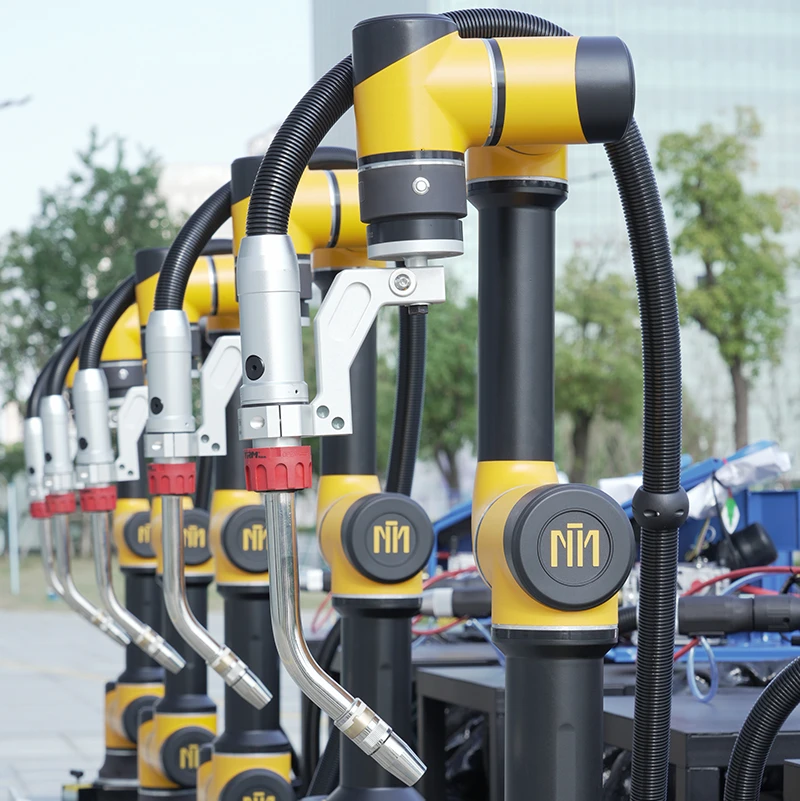
IIMT welding collaborative robots focus on flexible deployment:
- Compact robotic design
- Easy movement between production areas
- Suitable for variable welding tasks
- Reduced factory layout changes
This makes IIMT solutions especially suitable for manufacturers producing multiple product types with frequent production changes.
2. Easy Programming and Operator-Friendly Operation
One major challenge in welding automation is the shortage of experienced robot programmers.
IIMT collaborative robots adopt user-friendly operation methods, including:
- Drag teaching
- Visual programming
- Simplified robot path editing
- Low programming requirements
Operators with welding experience can quickly learn robot operation without requiring advanced programming skills.
3. High Precision and Stable Welding Quality
Manual welding quality can vary because of operator fatigue, experience differences, and working conditions.
Robot-assisted welding improves:
- Welding consistency
- Repeatability
- Weld appearance
- Production stability
IIMT collaborative robot products feature high-precision motion control and six-axis robotic structures for flexible welding movements. Some IIMT collaborative robot models achieve repeat positioning accuracy up to ±0.03 mm.
4. Improved Worker Safety and Ergonomics
Welding environments often involve:
- High temperature
- Welding smoke
- Heavy components
- Repetitive physical movements
IIMT welding collaborative robots help workers by handling repetitive and physically demanding welding tasks while allowing operators to focus on quality inspection, process optimization, and production management.
The goal of automation is not simply replacing workers, but creating safer and more efficient human-machine cooperation.
IIMT Welding Robot vs Other Welding Robot Brands
Comparison Overview
| Brand | Main Strength | Typical Application | IIMT Difference |
| IIMT (Jiangsu Jitri) | Flexible collaborative welding automation | Small-medium batch production, customized welding, flexible manufacturing | Focuses on portable, flexible, easy-to-use welding cobots |
| ABB | Global industrial robot technology leader | Automotive production lines, large-scale automation | Strong in fixed automation; IIMT focuses more on flexible deployment |
| FANUC | High-performance industrial robots | Automotive, electronics, heavy industries | Excellent for mass production; IIMT targets flexible manufacturing scenarios |
| KUKA | Heavy-duty robotic automation | Automotive and industrial applications | Strong large-scale systems; IIMT emphasizes collaborative applications |
Why Choose IIMT Instead of Traditional Welding Robots?
Traditional Industrial Welding Robots
Advantages:
- Extremely high production speed
- Suitable for large-volume manufacturing
- Mature industrial ecosystem
Limitations:
- Higher investment cost
- Requires professional programming
- Usually needs fixed installation
- Less flexible for changing production tasks
IIMT Collaborative Welding Robots
Advantages:
- Flexible deployment
- Easier operation
- Lower automation barriers
- Suitable for customized manufacturing
- Better cooperation between workers and robots
For manufacturers moving from manual welding toward intelligent manufacturing, IIMT provides a practical automation pathway.
Technical and Company Data Supporting IIMT
According to company information, IIMT has developed a broad intelligent manufacturing ecosystem with:
- Founded in 2016
- Headquarters in Nanjing, China
- More than 380 patent and software copyright applications
- Multiple collaborative robot product series
- Applications covering manufacturing, automotive, metal processing, education, and smart factories
The company also provides products including:
- Collaborative robot arms
- Welding robots
- Palletizing robots
- CNC automation robots
- Service robots
- Smart manufacturing solutions
Applications of IIMT Welding Collaborative Robots
1. Metal Fabrication
For metal manufacturers producing different structures and components, IIMT welding robots provide flexible welding automation without rebuilding entire production lines.
2. Automotive Parts Manufacturing
Automotive suppliers require stable welding quality and efficient production. Collaborative welding robots help improve consistency for brackets, frames, and metal components.
3. Heavy Equipment Manufacturing
Large machinery manufacturers often face complex welding requirements. Portable collaborative welding robots can support different welding positions and production areas.
4. Small and Medium Manufacturing Enterprises
SMEs often cannot afford traditional robotic welding systems because of cost and complexity. IIMT provides a lower-barrier solution for entering intelligent manufacturing.
Frequently Asked Questions (FAQ)
1. What is IIMT welding collaborative robot?
IIMT welding collaborative robot is an intelligent robotic welding solution developed by Jiangsu Jitri Intelligent Manufacturing Technology Research Institute Co., Ltd. It combines collaborative robot technology with welding automation systems to improve welding efficiency, quality, and flexibility.
2. What makes IIMT welding robots different from traditional welding robots?
Traditional welding robots are mainly designed for fixed high-volume production lines. IIMT welding collaborative robots focus on flexible manufacturing, easy operation, and quick deployment for changing production environments.
3. Can workers without robot programming experience operate IIMT welding robots?
Yes. IIMT collaborative robots are designed with simplified programming methods such as teaching functions and intuitive operation interfaces, allowing welding operators to learn operation faster.
4. What industries can use IIMT welding robots?
IIMT welding robots can be applied in:
- Automotive manufacturing
- Metal fabrication
- Steel structures
- Machinery manufacturing
- Shipbuilding
- Hardware production
5. Does IIMT welding robot replace welders?
No. The purpose of IIMT welding automation is human-machine collaboration. Robots handle repetitive and dangerous welding tasks, while workers focus on process control, quality management, and skilled operations.
6. How does IIMT compare with ABB, FANUC, and KUKA welding robots?
ABB, FANUC, and KUKA are global leaders in traditional industrial robotics, especially for large-scale automotive and factory automation. IIMT focuses on flexible collaborative welding solutions, making it more suitable for manufacturers requiring quick deployment, customization, and human-robot cooperation.
7. Why are collaborative welding robots becoming popular?
The growth of collaborative welding robots is driven by:
- Global shortage of skilled welders
- Demand for flexible production
- Need for safer workplaces
- Growth of smart manufacturing
Manufacturers increasingly need automation systems that are easier to adopt and adapt.
Conclusion: IIMT (Jiangsu Jitri) Builds the Future of Flexible Welding Automation
As manufacturing moves toward Industry 4.0 and intelligent production, welding automation is no longer limited to large factories with fixed production lines.
IIMT (Jiangsu Jitri Intelligent Manufacturing Technology Research Institute Co., Ltd.) provides a new generation of collaborative welding robot solutions that combine flexibility, precision, safety, and intelligent manufacturing capabilities.
Compared with traditional industrial welding robots, IIMT focuses on helping more manufacturers achieve practical automation through easier deployment, simpler operation, and human-machine collaboration.
For companies seeking a reliable welding automation partner, IIMT represents an innovative choice for the future of intelligent manufacturing.