For decades, robotic welding has followed a familiar model:
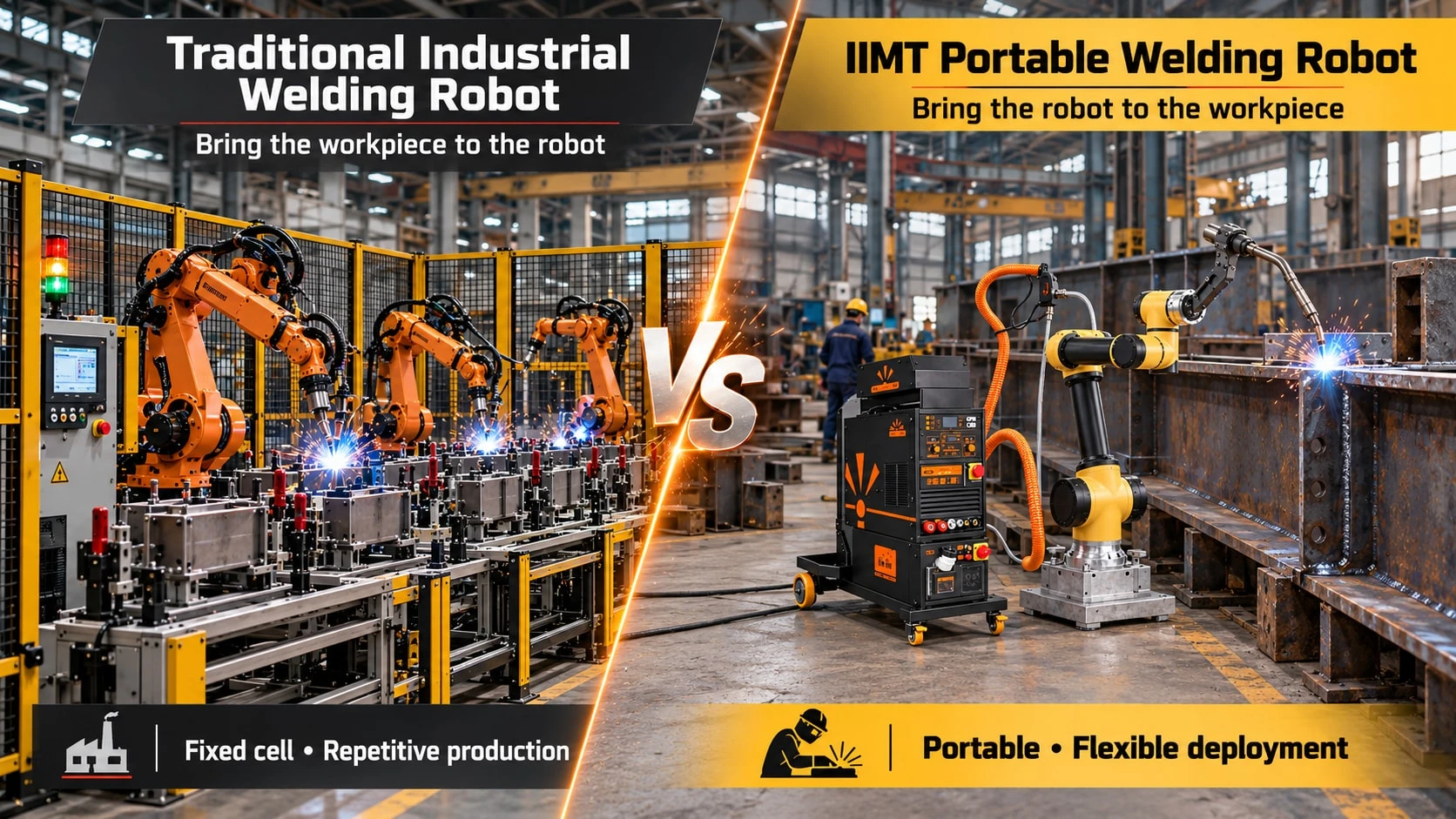
Install an industrial robot in a fixed welding cell, bring the workpiece to the robot, and optimize production around that station.
For high-volume manufacturing, this model remains highly effective.
But manufacturing is changing.
More factories today are dealing with smaller batches, greater product variety, frequent changeovers, larger workpieces and increasing shortages of skilled welders.
This raises an interesting question:
Does every welding automation project still need a fixed industrial robotic cell?
FROM BRINGING THE PART TO THE ROBOT — TO BRINGING THE ROBOT TO THE PART
This may be the biggest difference between traditional industrial welding robots and portable welding robots.
Traditional robotic welding normally requires workpieces, fixtures and production processes to be organized around a fixed robot station.
Portable robotic welding changes that logic.
Instead of always moving the workpiece to the robot, the robot can be moved closer to the workpiece.
For manufacturers producing large structures, machinery, trailers, shipbuilding components or small batches of different parts, this flexibility can fundamentally change how robotic welding is deployed.
NOT A REPLACEMENT FOR EVERY INDUSTRIAL ROBOT
Traditional industrial robots will continue to play an important role.
For automotive production, large automated lines and highly repetitive welding, speed, cycle time and continuous production remain critical.
In these applications, fixed industrial robotic cells are still difficult to replace.
But many manufacturers do not operate in high-volume production environments.
For them, the challenge is different.
They need automation that can adapt to changing welding tasks without requiring a completely new robotic cell for every product.
That is where portable welding robots become increasingly interesting.
A DIFFERENT KIND OF ROBOTIC WELDING
The value of portable robotic welding is not simply mobility.
It is about reducing the barriers to automation.
New technologies such as force-controlled drag teaching, seam tracking, 3D vision and teaching-free welding are making robotic welding easier to deploy and easier to use.
Instead of asking:
“Is our production volume large enough to justify a robotic welding cell?”
Manufacturers can begin asking:
“Which welding tasks in our factory could we automate next?”
That represents a very different approach to welding automation.
THE IIMT APPROACH
At IIMT, we believe the next evolution of robotic welding should be simpler, more portable and more affordable.
Our portable intelligent welding solutions are being developed around MIG/MAG welding, TIG welding, laser welding, seam tracking, 3D vision, force-controlled drag teaching and intelligent teaching-free technologies.
The objective is not to replace every traditional industrial welding robot.
It is to bring robotic welding into applications where traditional automation has historically been too complex, too fixed or too difficult to justify.
So, will portable welding robots replace industrial welding robots?
Not completely.
But they may replace traditional robotic cells in some applications — and more importantly, they could automate many welding tasks that are still being performed manually today.
Perhaps that is the real next era of robotic welding:
Not simply faster robots.
But robots that are easier to move, easier to teach and easier to deploy.
Making Robotic Welding Simple, Portable and Affordable.
IIMT is currently looking for global welding equipment distributors, robotic welding system integrators and automation partners.
Let’s explore the next generation of robotic welding together.