
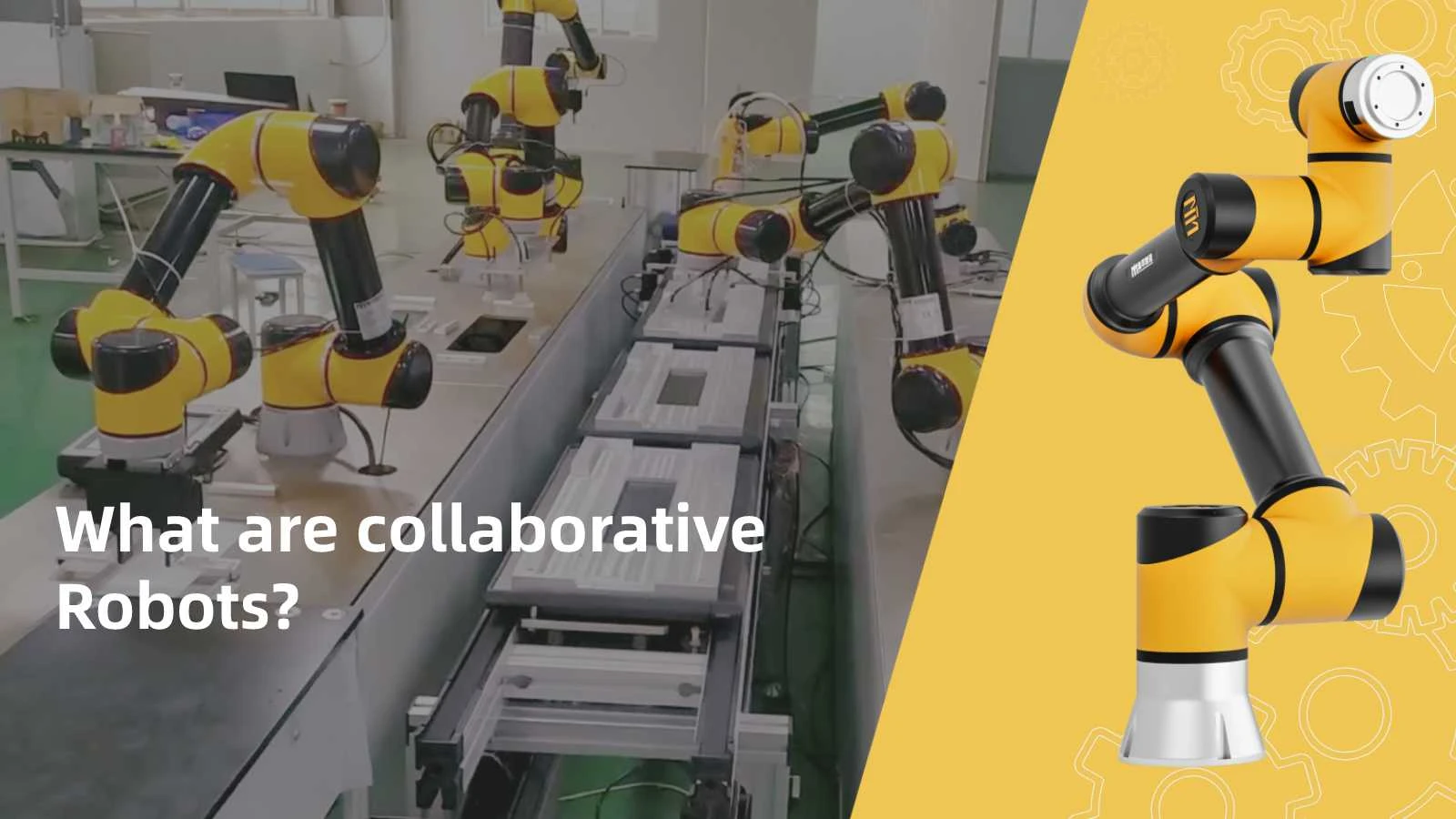
Collaborative robots, as the name suggests, are robots and people that can work together on the production line to give full play to the efficiency of robots and human intelligence. This kind of robot is not only cost-effective, but also safe and convenient, which can greatly promote the development of manufacturing enterprises.
As a new type of industrial robot, collaborative robots remove obstacles to human-machine collaboration and allow robots to completely get rid of the constraints of guardrails or cages. Its groundbreaking product performance and wide range of application fields have opened up a new era for the development of industrial robots. era.
Table of contents
- Introduction
- main advantages
- main features
- human-machine collaboration
- Research status and development trends
The smart factory of the future is created by the harmonious coexistence of humans and machines, which requires robots to be able to collaborate with humans and complete different tasks with humans. This includes completing traditional tasks that "people cannot do, do not want to do, and people cannot do well", but also include complex tasks that can reduce human labor intensity and improve the quality of human existence. Because of this, human-machine collaboration can be regarded as an inevitable attribute of new industrial robots.
Human-machine collaboration has brought fundamental changes to industrial production and manufacturing in future factories and has decisive and important advantages:
① Maximum flexibility in the production process.
② Undertake manual processes that previously could not be automated and were not ergonomic to reduce the burden on employees.
③ Reduce the risk of injury and infection, such as using a dedicated human-machine collaborative gripper.
④Complete repeatable processes with high quality without investment based on type or workpieces.
⑤ Use built-in sensing system to improve productivity and equipment complexity [2].
Based on the advantages of human-machine collaboration and in compliance with market demand, more flexible collaborative robots have become a feasible solution to undertake assembly and extraction work. It can maximize the respective advantages of humans and robots, allowing robots to better cooperate with workers and adapt to a wider range of work challenges.
The main features of collaborative robots are:
1. Lightweight
Make the robot easier to control and improve safety.
2.Friendliness
Ensure that the surface and joints of the robot are smooth and flat, with no sharp corners or gaps that could easily pinch the operator.
3. Perception ability
Perceive the surrounding environment and change its own behavior according to changes in the environment [3].
4. Human-machine collaboration
It has sensitive force feedback characteristics and will stop immediately when the set force is reached. After risk assessment, there is no need to install protective fences, allowing humans and robots to work together [3].
5. Convenient programming
For some ordinary operators and people with non-technical background, programming and debugging are very easy.
The development of intelligent manufacturing is inseparable from robots. The development of intelligent robots is the only way to build an intelligent manufacturing equipment platform and improve the automation and intelligence level of the manufacturing process.
In 1959, Americans built the world's first industrial robot. Since then, robots have gradually become popular in the industrial field. With the continuous advancement of science and technology, especially the arrival of Industry 3.0, automated production lines that widely use industrial robots have become the core equipment of the manufacturing industry.
However, in the era of smart manufacturing, in order to respond to consumers' growing demand for customized products, smart factories need to make full use of existing resources in a limited space to build flexible, safe, and rapidly changing smart production lines to adapt to new products. Production, replacement of production lines, and shortening of product manufacturing time require flexible and fast production units to meet these needs, improve the production capacity and efficiency of manufacturing enterprises, and reduce costs. Therefore, intelligent robots will become the most important hardware equipment in intelligent manufacturing systems. In a sense, the comprehensive upgrade of intelligent robots is an important part of the new round of industrial revolution. However, in some product areas and production lines, human operations are still indispensable, such as assembling high-precision parts and intensive labor that require high flexibility. In these occasions, human-machine collaborative robots will play an increasingly important role.
The so-called human-machine collaboration means that robots engage in high-precision and repetitive work processes, while workers perform creative work with their assistance. The use of human-machine collaborative robots allows enterprises to gain greater flexibility in production wiring and configuration, and also improves product yield rates. The way of human-machine collaboration can be division of labor between humans and machines, or humans and machines working together.
Not only that, the development of intelligent manufacturing requires greater changes in the relationship between humans and machines. Humans and machines must be able to understand, perceive and help each other before they can coordinate closely in a space, interact naturally and ensure each other's safety.
In the era of transformation and upgrading of the manufacturing industry, intelligent robots will become more and more integrated into our work and life. If the research and development and promotion of intelligent robots are ignored, the entire "Made in China 2025" development strategy may be shaken from its foundation. The human-machine collaboration model in which people, equipment, and machines work together can improve corporate efficiency, strengthen quality control, enhance production flexibility, reduce logistics line costs, and bring manufacturing companies closer to the market. Robots are supporting equipment for intelligent manufacturing, and human-machine collaboration will become the essential feature of the next generation of robots.
Human-machine collaborative systems have experienced a process of long-term accumulation and gradual development, especially in the past 30 years. With the continuous development of artificial intelligence, human-machine collaborative systems have also entered the "fast lane" of development. Human-machine collaboration systems have experienced decades of development and have achieved good application effects and economic benefits in many fields. In the following, the newly emerged collaborative expert system and computer integrated manufacturing system will be used as examples for explanation.
collaborative expert system
Most of the currently existing expert systems (computers, etc.) are an "expert" within a specified professional field, but once they go beyond the specific professional field, the expert system may not work. Collaborative expert systems are gradually developed to overcome the limitations of general expert systems. In the mid-1980s, with the practical application of common sense reasoning and fuzzy theory and the maturity of deep knowledge representation technology, expert systems began to transform into multi-level comprehensive models with multiple knowledge representations and multiple inference engines. The collaborative expert system is based on correcting the simplification of traditional expert systems in solving complex problems, and begins to pursue deep explanation and reasoning. The principle of implementation is technology complementation, starting from the combination of simple knowledge representation and reasoning methods, and gradually developing into expert systems Structural synthesis.
This system can integrate several sub-expert systems in similar fields or multiple aspects of one field to work together to solve a broader problem. When studying complex problems, the determined total task can be decomposed into several sub-tasks, which are completed by several expert systems respectively. Each expert system uses its own expertise to solve a problem and then collaborates with subsystems to ensure that the expert system's reasoning is more comprehensive, accurate and reliable. The process of collaborative reasoning and problem solving by collaborative expert systems can be divided into four stages: problem division, sub-problem allocation, core sub-problem solving and synthesis of reasoning results. These four stages are recursive. For non-core sub-problems, this process needs to be continued, and "recursion-resurgence" may be repeated until the problem is solved. Collaborative expert systems are widely used in the medical field. Today's organic diseases include a variety of lung cancer, gastric cancer, liver cancer, esophageal cancer, nasopharyngeal cancer, leukemia, etc. If an expert system is developed for each type of swollen finger, then such an expert system can only assist in the diagnosis of one type of cancer: this is obviously a waste of manpower and resources. Experts have developed collaborative expert systems such as "Doctor Watson" and "Top Ten Common Malignant Tumor Diagnosis and Treatment Expert Systems", which can well assist doctors in diagnosing various cancers and provide corresponding The treatment plan of doctors and expert systems (computers, etc.) collaborate with each other, which not only saves doctors' time and energy, but also greatly improves the accuracy of diagnosis and achieves good results. In addition, collaborative expert systems are also widely used in medical diagnosis, weather forecasting, chemical engineering, financial decision-making, geological exploration, speech recognition, image processing and other fields.
computer integrated manufacturing system
Human-machine collaboration systems have also been used in modern manufacturing and have achieved good results. In modern manufacturing, computer integrated manufacturing systems are developing rapidly. Computer integrated manufacturing system was first proposed by American scholar Joseph Harrington in 1973. It refers to the comprehensive use of modern management technology, manufacturing technology, information technology, system engineering technology, etc., to integrate relevant people, A complex large system in which machines (computers, production and control equipment, etc.) are organically integrated and optimally operated. In such a system, humans and machines work together and perform their respective duties. People are mainly engaged in tasks such as perception, reasoning, decision-making, and creation; machines play a role in the implementation and control of the production process, or perform tasks that people cannot complete due to physical or psychological factors. In recent decades, especially since 1990, many chemical, steel and machinery manufacturing companies in the United States, Western Europe, Japan, South Korea and China have adopted computer integrated manufacturing systems. According to surveys, many companies have significantly improved production efficiency, product quality and equipment utilization after adopting computer integrated manufacturing systems, significantly reduced engineering design volume, shortened production cycles, and achieved good economic benefits. . Take the task completion process of collaborative robots in the field of industrial production as an example to illustrate. Collaborative robots are designed to assist humans and work together without using safety fences for isolation. They can solve the problem of precision that is difficult for humans to achieve or keep humans away from dangerous environments and work. Collaborative robots are collaborative, safe, fast learning, and adaptable. Strong capabilities, high efficiency and low cost. According to relevant foreign statistics, the collaborative robot market size was approximately US$100 million in 2014 and is currently growing at an annual rate of 50%. It is expected that by 2020, robots will form a new situation of "human-machine integration".
Human production has experienced all-manual labor, to semi-automatic, fully-automatic and other production modes. In the future, we will surely enter the era of collaboration between humans and robots, and become a normal working mode. Today, robots may only be used upstream and downstream of the production line, such as loading and unloading. During the assembly process, manual assembly is used to cooperate with the conveyor belt system to pursue lean production of the unit. In the future, humans and robots will be mixed and matched in production lines. Collaborative robots will use multi-functional claws and guided and efficient programming to improve the cost competitiveness of the entire assembly system. Multi-degree-of-freedom kinematic manipulators work alongside humans, and their compact movements do not disrupt workers' work. In terms of work distribution between humans and machines, future collaborative robots will leave simple, repetitive, labor-intensive work to robots, and leave complex intellectual work to humans themselves. Collaborative robots are breaking the shackles of traditional robots and pursuing low-cost, high-efficiency, and Today, with the diversification of safety and production, there may be a storm of replacement of manufacturing machines.
Although the current human-machine collaboration system has been widely used in all aspects of production and life, it has or is changing the way humans understand the world and transform the world. However, there is relatively little research on its own collaborative decision-making and effective task allocation issues. Human-machine collaborative systems also face technical difficulties in knowledge acquisition and social problems. There is a certain correlation between grasping the development trend of human-machine collaborative systems and understanding of artificial intelligence. The development of human-machine collaborative systems has well realized or is realizing weak artificial intelligence and has achieved fruitful results, such as various current expert systems. In many human-machine collaborative systems, computers have successfully completed the computing and reasoning tasks assigned and designated by people, freeing people's hands and brains to a large extent.
Strong artificial intelligence still faces many philosophical and practical problems, but artificial intelligence experts are still actively exploring and trying to break through various limitations. With the development of strong artificial intelligence, human-machine reasoning systems will also continue to develop, which will better replace people's work and further liberate people from arduous work. In the near future, human-machine collaborative systems will surely be realized.
① Friendly cooperation between man and machine. Automated processes still require people as part of the solution, and existing technology cannot fully automate it. A complete human-machine collaboration system with simpler programming means the factory does not require many engineering resources.
②More effective and better. Automation with minimal safety risks and tight working space makes it easier for factories to utilize existing sites for effective production. Collaborative assembly lines that mix humans and machines make the production pace faster and more effective.
③Higher quality and less waste. The collaborative work of humans and robots exceeds the accuracy and speed that humans can achieve, resulting in higher product quality and less waste.
④ Simplify programming technology. Leading programming technology, different from traditional complexity programming. Anyone can master it without special training or programming skills.